
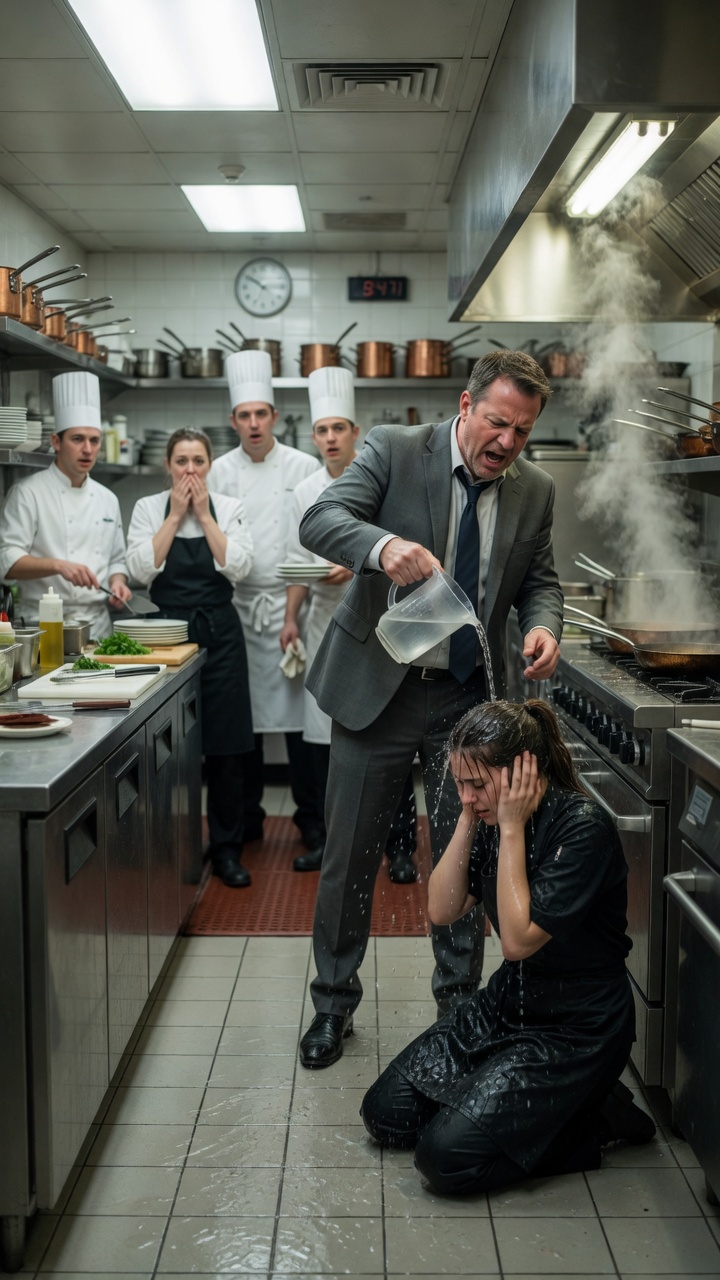
“My daughter just texted me from the restaurant kitchen, terrified: ‘Mom, the new manager is accusing me of stealing cash! He’s calling the police!’ I replied: ‘Lock yourself in the storage room. I’m coming.’” I didn’t call anyone else, didn’t alert security, didn’t create panic or noise—I simply stood up slowly from the table where I had been sitting quietly, blending in as nothing more than an unremarkable guest during an unannounced inspection, because that was the entire purpose of nights like this: to see the truth when no one knew they were being seen, to hear what people said when they thought their words would never be questioned, and to understand exactly how power moved when it believed itself unchecked, because I wasn’t just any guest in that dining room—I was Eleanor Whitmore, Chairwoman of the Board of the Regency Grand Hotel in Los Angeles, and tonight someone had just made a mistake so severe it would not only cost them their job, but everything they thought they controlled. From the penthouse dining level overlooking the glowing skyline of the city, I had been observing everything through internal security feeds, not out of suspicion alone but out of experience, because patterns always reveal themselves if you are patient enough to watch, and for weeks I had been watching one particular pattern take shape around a man named Brandon Hayes, the newly appointed night manager whose polished confidence and carefully rehearsed charm had impressed nearly everyone at first glance, but confidence that performs too perfectly often hides something far less controlled beneath the surface, and in Brandon’s case it was subtle at first—slight inconsistencies in reporting, minor discrepancies in staff complaints, the quiet discomfort of employees who didn’t dare speak directly but expressed it through hesitation, body language, silence—and then gradually it became clearer: authority used just a little too aggressively, decisions made not for efficiency but for dominance, a tone that shifted depending on who was listening, and tonight that pattern had finally crossed the line from suspicion into undeniable action. My phone buzzed again, cutting through my thoughts with a sharp urgency that needed no interpretation, a second message appearing on the screen: “MOM PLEASE HURRY.” There are moments in life when anger demands to be felt immediately, when instinct tells you to react without thinking, but there are other moments—far more important ones—when precision matters more than emotion, when control becomes the most powerful response, and this was one of those moments, so I moved without rushing, stepped into the elevator, and let the quiet descent give me exactly what I needed: clarity. By the time the doors opened, I was no longer a concerned mother—I was a decision already made. The kitchen doors swung open with a rush of heat, noise, clattering metal, voices overlapping in chaotic rhythm, but beneath all of it there was something else—something quieter and far more telling—the tension that filled the room like invisible pressure, the kind that silences people without anyone asking them to be quiet, and I felt it immediately as I stepped inside and saw him standing near the back office door, his posture rigid, his voice raised in a sharp, theatrical tone designed not just to accuse but to dominate, “You think you can hide from me? The money’s gone, and you’re going to jail! Open this door!” Around him, staff had gathered in uneven clusters, some openly watching, others pretending to continue working while clearly listening, no one stepping forward, no one interfering, because situations like this reveal more than just the person at the center—they reveal everyone around them too. I walked forward slowly, deliberately, my steps steady enough to draw attention without demanding it, and when he turned toward me, irritation already forming on his face, I could see it instantly—the kind of man who believed authority belonged to whoever spoke the loudest, “Hey! This is staff only—who the hell are you?” I stopped directly in front of him, met his eyes without raising my voice, without matching his energy, because control does not need volume to be understood, “I’m the person the girl you’re falsely accusing just called for help.” He smirked in response, dismissive, almost amused, the kind of cruelty that comes from believing there will be no consequences, “Mommy came to save the day. Move aside. You’re about to watch your daughter get arrested.” He reached out as if to push me aside, a gesture he had likely used before without resistance, but I didn’t move, didn’t react, didn’t even acknowledge the attempt, because the most effective way to dismantle false authority is not to confront it directly—but to step outside of it entirely, so instead I turned my back on him, an action so deliberate it forced everyone in the room to reconsider the balance of power without a single explanation, and I walked toward the floor supervisor, Jason Keller, who stood frozen between responsibility and uncertainty. “Jason,” I said, and in that moment my voice changed—not louder, not harsher, but unmistakably different, no longer a guest, no longer neutral, but command in its purest form, “Call the CEO immediately. Tell him Chairwoman Whitmore is requesting his presence in the kitchen for a level-three staff safety violation, corporate misconduct, and a potential criminal defamation case.” The effect was immediate and absolute, as if the entire room had been pulled into silence at once, conversations cut off mid-thought, movement paused, even the relentless noise of the kitchen seemed to dim under the weight of what had just been said, and when Brandon spoke again, the shift in his voice was undeniable, “What… did you just say?” I turned back to him slowly, giving him exactly the same calm he had mistaken for weakness only moments before, “You heard me.” It’s a rare thing to witness the exact second someone loses control, but in that moment it was visible to everyone in the room, his confidence collapsing not all at once but in fragments, hesitation replacing certainty, doubt replacing authority, “M-Ma’am… Chairwoman… I—I can explain—she stole—five hundred dollars—” I didn’t let him finish, because explanations built on lies do not deserve space to grow, “I know my daughter didn’t steal a single dollar,” I said, stepping closer, removing the distance he had used as protection, “and I know that you did.” The silence that followed wasn’t just quiet—it was heavy, final, the kind that settles into people and forces them to recognize what they’ve been witnessing all along, because for the first time since this began, he no longer controlled the narrative, and without that control, everything else began to fall apart. Corporate security arrived within minutes, their presence precise and unquestionable, not the negotiable authority of local enforcement but the structured force of an organization protecting its own integrity, and Brandon tried one last time to recover, to reshape the situation into something manageable, “I was just following procedure—” but control had already shifted beyond him, “Good,” I replied calmly, “then you won’t mind if we review the footage.” Jason hesitated only briefly before moving to the monitor, his actions now guided by clarity instead of fear, and when the screen flickered to life, the truth required no interpretation: timestamped, unmistakable, Brandon alone, opening the deposit bag, removing cash, scanning the room, and then deliberately separating the money into another envelope, constructing the very accusation he had just been shouting, and as the footage played, the reaction spread through the room in waves—gasps, whispers, disbelief turning into understanding faster than anyone could articulate it, “That’s not what it looks like—” he said, but the words carried no weight anymore, “It’s exactly what it looks like,” I answered, not with anger, but with certainty. Security stepped forward, “Sir, you’ll need to come with us,” and this time there was no authority left in him to resist, only panic, raw and exposed, “I needed the money—I was going to put it back—this isn’t—” but no one was listening, because the truth had already spoken louder than any explanation could, and within moments he was gone, removed from the very space he had tried to control, leaving behind a silence that felt entirely different now—not tense, but released. Only then did I turn toward the storage room door, the place where all of this had begun, and I approached it slowly, gently knocking, allowing my voice to soften for the first time since I had entered, “Emily… it’s me.” There was a pause, a moment where fear still held its ground, and then the sound of the lock turning broke through the quiet, the door opening just enough to reveal my daughter standing there, her eyes red, her hands trembling, but still standing, still holding herself together despite everything she had just endured, “Mom…” she said, and in that single word was every ounce of fear, relief, and disbelief she had been carrying, and I pulled her into my arms, holding her tightly, not as a chairwoman, not as a figure of authority, but simply as her mother, “You’re safe,” I told her, and she held onto me as if she had been holding her breath this entire time, “I didn’t do anything wrong…” she whispered, and I answered without hesitation, “I know—I always know.” Later that night, the restaurant returned to order, the systems resetting, the routines continuing as they always do, but something fundamental had changed, because once truth is exposed, you don’t return to ignorance—you move forward with awareness, and the following morning that awareness became policy, a company-wide message delivered without ambiguity: zero tolerance for abuse of power, protection for every employee regardless of position, accountability enforced at every level, no exceptions, no excuses, no silence allowed to protect misconduct, and while the organization adjusted to that clarity, for Emily the lesson was something far more personal, something quieter but no less powerful, as she sat across from me later that evening, still processing everything that had happened, “I didn’t think anyone would believe me,” she said, and I looked at her not as a leader, but as someone who understood exactly how easily truth can be ignored when it is inconvenient, “You don’t need everyone to believe you,” I told her, “you just need one person who refuses to ignore the truth,” and as she nodded slowly, understanding settling into her expression, I realized that what had changed that night wasn’t just a situation or a policy—it was perspective, because power, real power, is not about control or fear or authority used to silence others, it is about responsibility, about choosing to act when others remain still, about recognizing that silence is not neutrality but participation, and in that kitchen, in that moment, something shifted not just for us, but for everyone who had witnessed it, because sometimes the most dangerous person in the room is not the one abusing power—it is everyone who sees it happening and chooses to say nothing, and the question that remains, long after everything is resolved, is simple and unavoidable: when that moment