The Saleswoman Mocked a Poor Father in a Jewelry Store… Until She Learned His Daughter Owned Everything
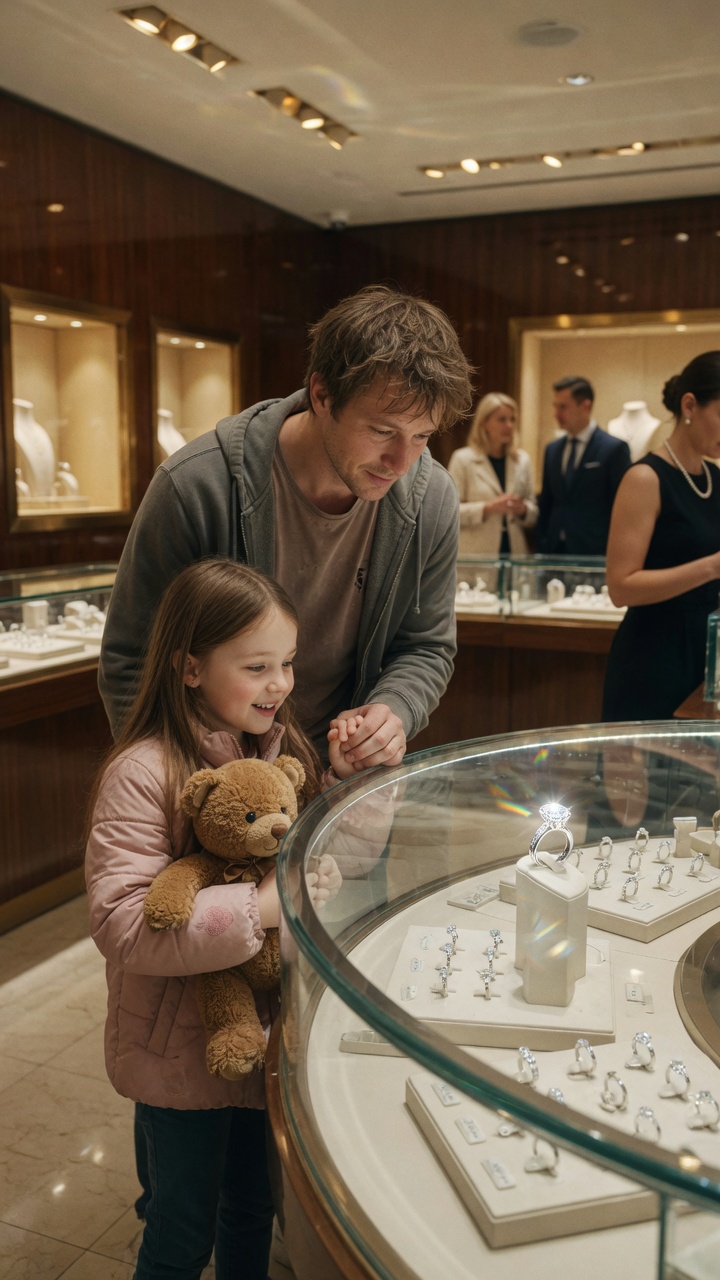
A little girl entered a luxury jewelry store holding her father’s hand. She was small, no more than seven years old, wearing a simple blue dress, white sneakers, and a pink hair clip that kept slipping loose from her soft brown hair. In her other arm, she hugged a worn plush rabbit so tightly that one of its stitched ears bent against her chest. Her father walked beside her in a gray hoodie, faded jeans, and scuffed shoes, his face tired but gentle. To anyone watching from a distance, they looked like they had wandered into the wrong place. The jewelry store was bright, elegant, and intimidating. Gold light spilled over glass counters filled with diamonds, pearl earrings, engagement rings, and delicate bracelets displayed on velvet stands. A chandelier glittered above them. The floor was polished marble. The air smelled faintly of expensive perfume and fresh flowers. Wealthy customers moved quietly from case to case, speaking in low voices, while sales staff in black suits smiled with perfect manners at anyone who looked rich enough to deserve them. The little girl stopped in front of one display and pressed closer to the glass. Her eyes widened. Inside was a tiny gold necklace with a small heart-shaped pendant, simple but beautiful, glowing softly beneath the lights. She pointed at it and whispered, “Daddy… that one.” Her father looked down at her, and for a moment, sadness crossed his face so quickly that only someone who loved him would have noticed. He tried to smile. “For your birthday,” he said softly. The girl looked up at him, hopeful. “Really?” He squeezed her hand. “Really.” But before he could ask to see it, a blonde saleswoman behind the counter glanced over. Her eyes moved from the child’s worn plush toy to the father’s gray hoodie, then down to his shoes. Her smile did not reach her eyes. “Can I help you?” she asked, though her tone made it clear she did not believe she could. The father nodded politely. “My daughter would like to see that necklace.” The saleswoman looked at the necklace, then back at him. A small smirk touched her lips. “That piece is real gold,” she said. “We don’t have anything in your price range.” The store went silent. Not completely at first—just a soft drop in the room, like air being pulled away. A woman near the bridal cases stopped turning a ring on her finger. A man in a navy suit looked up from his phone. Even the security guard by the door shifted awkwardly. The little girl hugged her plush toy tighter. Her cheeks flushed red. She looked down at her shoes as if she had done something wrong. The father’s jaw tightened, but he did not raise his voice. “She only asked to see it.” The saleswoman folded her hands on the counter. “And I’m only trying to save you embarrassment.” The child’s fingers tightened around her father’s hand. “Daddy,” she whispered, “we can go.” He looked down at her, and the hurt in her voice cut deeper than the insult. He had brought her here because it was her birthday week. Because she had passed the store window three times and stared at that necklace each time like it was a piece of captured sunlight. Because he had promised himself, after everything she had lost, that she would never again be made to feel small for wanting something beautiful. He opened his mouth to answer, but before he could speak, the front doors of the store swung open. A silver-haired man in a blue suit rushed in, breathless, carrying a leather folder under one arm. He stopped when he saw the father standing at the counter. His face changed instantly. Relief, sorrow, and respect all crossed it at once. He hurried forward, stopped beside the father, and lowered his head. “Sorry, sir…” The saleswoman froze. The older man’s voice shook. “…they don’t know who you really are.” The father whispered, “Please… not in front of my daughter.” The older man looked pained. “But sir, this store belongs to you.” The saleswoman turned pale. The little girl looked up, confused. “Daddy?” For a moment, the entire jewelry store froze. The soft golden lights above the glass counters continued to glow, diamonds still sparkled beneath velvet displays, and the faint scent of expensive perfume lingered in the air—but no one moved. The wealthy customers who had been pretending not to watch now stared openly. The security guard near the entrance lowered his hand from his radio. The young saleswoman, who only minutes earlier had laughed at the father’s worn hoodie and told him there was nothing in his price range, suddenly looked as if the floor had disappeared beneath her designer heels. The father swallowed hard. His name was Daniel Carter, though almost no one in that room knew it yet. To them, he had looked like a tired man in an old hoodie, holding the hand of a little girl in a faded blue dress who had only wanted to admire a necklace she thought she could never have. The saleswoman had judged him in seconds. She had looked at his clothes, his quiet voice, his daughter’s cheap hair clip, and decided they were not worth kindness. “Sir…” the older man said again, his voice trembling with emotion. Daniel raised one hand slightly, begging him to stop. His eyes flicked toward his daughter. Not here. Not like this. But it was already too late. The little girl, Lily, tightened her fingers around his sleeve. “Daddy, what does he mean?” Daniel slowly lowered himself to one knee beside her. He tried to smile, but his mouth trembled. Then he reached into the pocket of his hoodie and pulled out an old leather wallet, the edges cracked from years of use. His hands shook as he opened it. Inside, tucked behind an expired library card and a folded grocery receipt, was a faded photograph. The picture showed the same jewelry store years earlier, before the marble floors were replaced, before the golden logo was polished, before strangers in suits ran it like it had no soul. Standing in front of the entrance was a young woman with bright eyes and a gentle smile, one hand resting proudly on the glass door. Lily leaned closer. “Is that Mommy?” Daniel nodded, and his voice broke. “Yes, sweetheart.” The little girl stared at the photo. She had seen pictures of her mother before—on Daniel’s bedside table, in the old album they kept wrapped in cloth, in the locket he never let anyone touch. But she had never seen this one. She had never seen her mother standing in front of this beautiful store as if it belonged to her. Daniel brushed his thumb over the woman’s face in the photo. “Your mom built this place for you.” Lily blinked. “For me?” “Yes,” he whispered. “Before you were born, your mother dreamed of opening a jewelry store that didn’t just sell expensive things. She wanted it to be a place where every woman who walked in felt seen. Brides, mothers, daughters… even people who could only afford a small silver ring. She used to say jewelry wasn’t about money. It was about memory.” The older man behind the counter lowered his head. His name was Mr. Henry Wallace, and he had worked there since the store first opened. He had known Lily’s mother, Emily Carter, before the world forgot who truly built the business. Daniel looked up at him, pain heavy in his eyes. “I didn’t bring her here for this.” Mr. Wallace’s voice was thick. “I know, sir.” The saleswoman, still pale, whispered, “I… I didn’t know.” Daniel stood slowly. This time, when he looked at her, his expression was not angry. It was worse. It was disappointed. “You didn’t know we owned the store,” he said quietly. “But you knew she was a child.” The woman’s lips parted, but no excuse came out. “You knew she was excited,” Daniel continued. “You knew she wasn’t hurting anyone. You knew all she wanted was to look at something beautiful.” Lily hid slightly behind his coat, confused by the heavy silence around her. Daniel felt her small hand searching for his, and he immediately took it. Then Mr. Wallace carefully placed a velvet box on the counter. It was deep navy blue, old but perfectly preserved. He opened it with both hands as if opening something sacred. Inside lay the delicate gold necklace from the display, simple and elegant, with a small heart-shaped pendant. But this one was not merely similar. It had been made long before Lily ever saw it through the glass. On the back of the pendant, engraved in tiny letters, was one name: Lily. The little girl gasped softly. “That’s my name.” Daniel’s eyes filled with tears. Mr. Wallace nodded. “Your mother ordered it before you were born.” Lily looked up at Daniel. “Mommy bought this for me?” Daniel could barely speak. “She designed it.” Mr. Wallace gently turned the pendant over. “She came into the workshop herself. She was very pregnant then, always tired, but she refused to rest. She said, ‘When my daughter is old enough, I want her to know she was loved before she even opened her eyes.’” A quiet sob escaped one of the customers near the bridal section. Another woman covered her mouth. Daniel closed his eyes for a second. He remembered that day. Emily had come home with swollen feet, pretending she was fine, carrying sketches in her purse and laughing when he told her she needed to slow down. She had tapped his chest and said, “Our daughter deserves something made with love, not just money.” Two months later, Emily was gone. A sudden illness. A hospital room. A final goodbye he was not ready to give. After her death, Daniel had disappeared from the business. Grief had swallowed him whole. Emily’s relatives and a few ambitious managers had stepped in, claiming they were “protecting the company.” Papers had been moved. Decisions had been made without him. The store kept her name on the documents, but not in its heart. Daniel had let them take control because he could barely get out of bed, let alone fight for a jewelry empire. But he had never sold it. He had never signed away Lily’s inheritance. And now, standing in the store Emily built, watching his daughter be humiliated by a woman hired to represent it, Daniel understood something painful and clear. He had stayed away too long. Mr. Wallace looked toward the saleswoman. “Miss Parker, do you understand whose child you just insulted?” The saleswoman’s voice shook. “I’m sorry. I truly am. I didn’t mean—” Daniel cut her off softly. “You did mean it. You just didn’t think there would be consequences.” The store manager, who had been standing frozen near the back office, hurried forward. “Mr. Carter, please, we can handle this privately. I assure you, this is not how we conduct business.” Daniel turned to him. “Isn’t it?” The manager stopped. Daniel looked around the room. At the polished counters. At the employees pretending to be busy. At the customers still watching. At the necklace Emily had left behind for their daughter. “My wife built this store with kindness,” he said. “And somehow, after I stepped away, it became a place where a little girl could be mocked because her father didn’t look rich enough.” No one answered. Daniel reached for the velvet box, then knelt again in front of Lily. “Do you want to wear it?” he asked. Lily looked at the necklace, then at the photograph still in his hand. “Will it make Mommy happy?” That question shattered him. Daniel smiled through tears. “I think Mommy would be very happy.” He fastened the necklace around her small neck. The gold pendant rested against her dress, glowing softly beneath the store lights. Lily touched it with two fingers, careful and amazed. “It’s pretty,” she whispered. “It was made for you,” Daniel said. Mr. Wallace wiped his eyes. “Your mother said yellow gold would suit you. She said you would be bright.” Lily smiled for the first time since they had entered the store. “Daddy says I’m bright too.” Daniel pulled her gently into his arms. “You are.” Then his expression changed. Not harshly, but with quiet authority. He stood, still holding Lily’s hand, and turned to the manager. “I want every employee record on my desk by tomorrow morning.” The manager swallowed. “Your desk, sir?” Daniel looked toward the back office. “My wife’s office. I assume it’s still there.” Mr. Wallace nodded immediately. “Untouched, sir. I made sure of it.” Daniel looked at him, surprised. The old man’s voice softened. “Some of us remembered.” That nearly broke Daniel all over again. He nodded once. “Thank you, Henry.” The saleswoman began crying quietly. “Please, Mr. Carter. I need this job.” Daniel looked at her for a long moment. Then he said, “So do many people. And they still choose decency.” She lowered her head. “I won’t decide your future tonight,” Daniel continued. “Not in front of my daughter. But you will write her an apology—not because she owns anything, not because her name is on paperwork, but because she is a little girl you treated cruelly.” The saleswoman nodded quickly. “Yes. Of course.” Daniel’s voice became colder. “And tomorrow, this store closes for training. Every employee. Every department. Customer service, ethics, and the original mission of this company.” The manager’s face tightened. “Sir, closing even one day before the holiday season would cost—” Daniel turned to him. “My wife’s legacy is already paying the cost.” The manager went silent. Lily tugged on Daniel’s hand. “Daddy, are you mad?” He looked down, and his face softened instantly. “Not at you.” “Can we go home?” He crouched again. “In a minute.” Then Mr. Wallace stepped forward with another item: a small envelope, yellowed at the edges. “Sir,” he said quietly, “Mrs. Carter left this with the necklace.” Daniel froze. His name was written on the front in Emily’s handwriting. For several seconds, he could not take it. The sight of her letters was enough to pull him back into every night he had spent alone after she died, every morning Lily had asked why Mommy wasn’t coming back, every birthday where he smiled only because his daughter needed him to. Finally, he opened it. Inside was one page. Daniel read silently at first, but Lily leaned against him, so he lowered himself beside her and read aloud with a trembling voice. “My love, if you are holding this, then our daughter is old enough to know where she came from. I don’t care if this store becomes famous. I don’t care if it makes millions. I only care that Lily grows up knowing love can build something beautiful. Promise me you won’t let this place become cold. Promise me you’ll remember that people matter more than diamonds. And promise me our little girl will always know she was my greatest treasure.” By the time he finished, Daniel could no longer hide his tears. Lily wrapped her small arms around his neck. “Don’t cry, Daddy.” He held her tightly. “I’m okay, sweetheart.” But he wasn’t okay. Not yet. He had thought protecting Lily meant keeping her away from painful memories. He had thought avoiding the store would spare them both. But now he realized he had not protected her from grief. He had only left Emily’s dream in the hands of people who did not understand it. That ended tonight. Daniel stood and folded the letter carefully. “We’re going home,” he told Lily. “But we’ll come back tomorrow.” Lily looked up. “To Mommy’s store?” He nodded. “To Mommy’s store.” The next morning, for the first time in four years, Daniel Carter walked into the office above the jewelry store. Dust floated in the sunlight. Emily’s framed sketches still hung on the walls. Her old coffee mug sat beside a jar of pencils. A yellow sticky note with her handwriting was still attached to the edge of the desk: Kindness is luxury too. Daniel stood there for a long time, holding Lily’s hand. Then he opened the blinds. Below them, the store employees gathered in silence. No one laughed now. No one whispered about his coat. No one dared treat Lily like she did not belong. Daniel looked at his daughter. “This is part of your mother,” he said. “But you don’t have to carry it today.” Lily touched her necklace. “Can we make it nice again?” Daniel smiled softly. “Yes.” And that was how everything began to change. The saleswoman wrote her apology. Daniel read it first, then gave it to Lily only after making sure it did not sound like an excuse. The manager resigned two weeks later after an internal review exposed years of arrogant policies, employee mistreatment, and quiet discrimination against customers who did not look wealthy enough. Mr. Wallace became interim director, and Daniel returned—not as the grieving widower hiding from memory, but as the father of the girl Emily had built everything for. They changed the store’s entrance policy. No customer could be ignored because of clothing, accent, age, or appearance. A new display was placed near the front window, not with the most expensive diamonds, but with Emily’s original sketches and a small sign that read: Founded on memory. Built with kindness. On the first anniversary of Daniel’s return, Lily stood beside him in front of the same glass doors from the faded photograph. She wore a yellow dress and the gold necklace with her name on it. Cameras flashed this time, but Daniel did not care about publicity. He cared about Lily’s smile. A reporter asked her, “Do you know this store belongs to you one day?” Lily looked up at her father, then back at the reporter. “It belonged to my mommy first,” she said. “And Daddy says we have to take care of things people made with love.” Daniel looked away for a second, overcome. Mr. Wallace stood near the doorway, smiling through wet eyes. That evening, after the store closed, Daniel and Lily stayed behind. The lights were dimmed. The city outside moved beyond the glass. Lily pressed her hand against the photograph of Emily displayed near the entrance. “Goodnight, Mommy,” she whispered. Daniel stood beside her, one hand resting gently on her shoulder. For the first time, the store did not feel like a place grief had locked away. It felt like a promise reopened. And as Lily’s necklace caught the soft golden light, Daniel finally understood what Emily had been trying to leave behind. Not wealth. Not status. Not diamonds. A home. A memory. A place where their daughter would never again be made to feel small.