She Was Thrown Out With Her Baby… Then an Abandoned Ranch and a Newborn Foal Chose Her Back
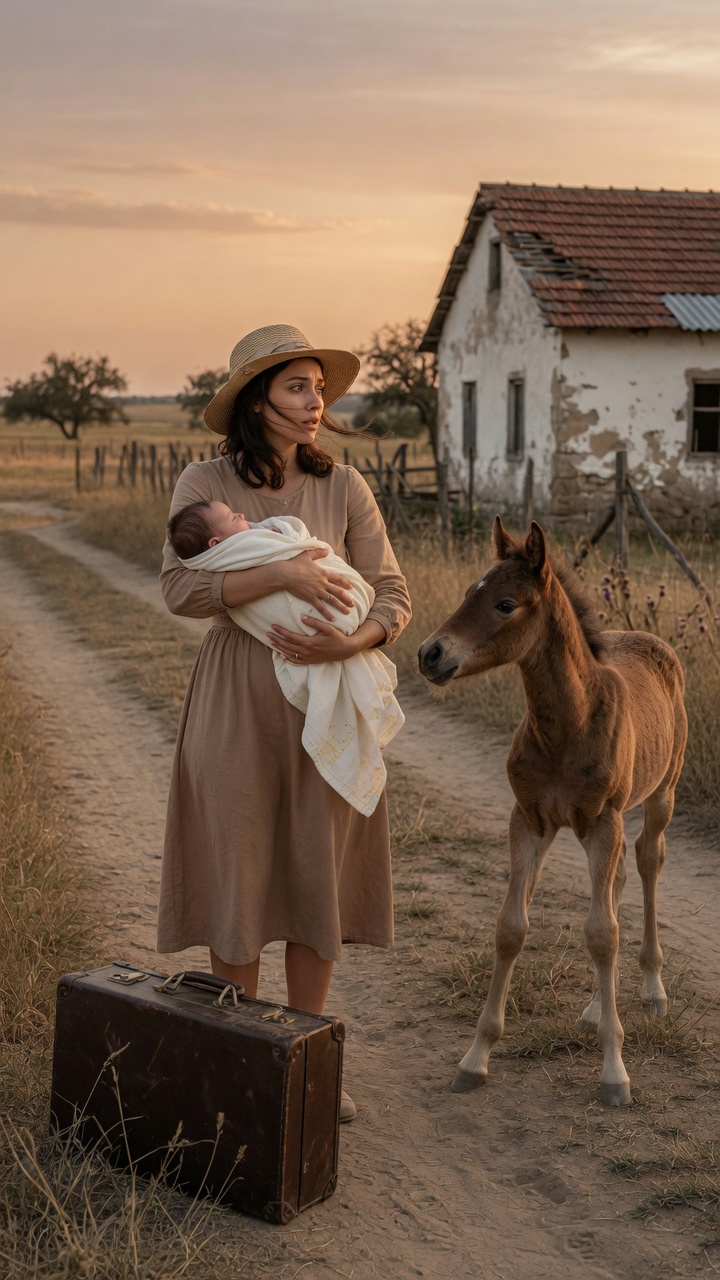
The suitcase fell onto the dirt with a dry thud, and the sound was so harsh that even the baby stopped crying for an instant. “I told you this house is no longer for you,” Mrs. Eleanor spat from the doorway, a black shawl pulled tightly over her shoulders and a gaze made of stone. “My son is dead. Dead, do you understand? And you have no right to stay here as if nothing happened.” Hannah did not answer immediately. She held baby Samuel in her arms, pressed against her chest, sweaty, restless, his little face red from crying. The child was barely three months old and already knew the open cruelty of the world better than many old men. Hannah felt her left arm going numb from his weight, but she held him tighter. On the other side of the gate, two neighbors pretended to sweep the sidewalk while watching from the corners of their eyes. In small towns, someone else’s misery always finds witnesses. “I’m not asking for anything free, Mrs. Eleanor,” Hannah finally said in a low voice, careful not to let the tremor show. “Just a few more days. Until I find somewhere to go with the baby.” Her mother-in-law let out a short, hollow laugh with no joy in it. “And what are you going to find anything with? That sad widow face? That brat hanging from your arm? My son drowned because he was always thinking about supporting you. Ever since you came here, a dark shadow fell over this family.” The words struck harder than the midday sun. Hannah was not a woman who cried easily, but she felt something open inside her—not from new pain, but from old pain deliberately stirred awake. Michael had been underground for three months. Three months since the swollen river, wild from the March rains, swallowed him along with three cattle and half a life still waiting to be lived. Three months since the people in town had looked at her with that mixture of pity and curiosity reserved for fresh tragedies. Three months, and Mrs. Eleanor had not cried in front of her once. Instead, she had chosen to turn her son’s death into a stone she could throw at Hannah every day. “Don’t say that,” Hannah murmured, and in that voice lived the exhaustion of entire weeks without one full night of sleep. “You know it isn’t true.” “What is true is that I am in charge here.” Then Mrs. Eleanor stepped forward, grabbed the old leather suitcase—the same one Hannah had carried the day she married Michael—and threw it down the porch steps as if it were an empty sack. The lock broke. A patched dress, two cloth diapers, a thin blanket, and a small cardboard photograph spilled across the ground. Samuel let out a sharp cry. Hannah felt shame climb up her neck and into her face, but she did not bend down yet. She looked straight at her mother-in-law. Mrs. Eleanor’s lips were pressed tight, her jaw hard, wearing the expression of a woman convinced that cruelty becomes justice when she is the one delivering it. “Take your things,” she said. “And take the child, because after all, he is yours. Don’t take up space here anymore.” Hannah remained still. There was one strange second, just one, when the world seemed to stop. She could hear the buzzing of flies, Samuel’s crying, the creak of a rocking chair inside the house, the distant murmur of a wagon passing along the main street. And she could hear something deeper too: the sound of a life splitting in half. She bent down without hurry. First she picked up the photograph of Michael. Then the blanket. Then the diapers. She did it with such precise calm that the neighbors on the sidewalk lost their taste for gossip for a moment. Then she closed the broken suitcase as best she could, adjusted the baby against her chest, and walked down the steps without looking back at the house. “God sees you, Mrs. Eleanor,” she said only, without raising her voice. The other woman did not answer. Hannah left the town that same afternoon. She did not tell anyone because she had no one to tell. Her father had died when she was a child. Her mother had passed two years earlier, consumed by fevers that left her dry as an old leaf. She had no siblings. Cousins, if they existed, were so far away they were almost only an idea. The only thing resembling living family was an address written on a piece of paper: that of a great-aunt named Martha, her mother’s sister, who lived in a town several days away, inland, beyond any place Hannah had ever gone in her life. She left with the clothes on her back, a half-broken suitcase, a straw hat, worn boots, a little corn flour, brown sugar, dried meat, and a fear so large she had to learn to walk with it like someone carrying a sack on her back. The first days on the road were a long test of dust, hunger, and silence. She slept wherever she could: under the porch of an abandoned chapel, behind a storage building, once in a barn a rancher lent her after seeing her with the baby. She ate little and slowly, making every piece last as if she could trick time that way. Samuel was still nursing, and as long as she had milk, the child would not have an empty stomach. But Hannah knew the account her own body was keeping. Each day with little food meant less milk tomorrow. Each night without rest meant more weakness at dawn. Still, she kept going. Not because she was brave in the pretty way people later tell stories. She kept going because not stopping was the only way not to die all at once. On the eighth day, she reached the town where Aunt Martha was supposed to live. The house was closed. Hannah stood staring at the wooden door with a strange fixed gaze, as if looking at it long enough could change the outcome. She knocked once. No one. Twice. Nothing. A neighbor sweeping the sidewalk told her, without taking the cigarette from his mouth, that Mrs. Martha had gone to the capital five months earlier, taken by a nephew. He did not know if she would return. A family friend checked the house from time to time. No one lived there. Samuel woke at that exact moment and began to cry. It was not a hungry cry. It was that broken cry babies make when they feel the world around them has twisted, though they still do not know how to name it. Hannah did not cry. She could not. There are pains that empty a person inside before allowing a single tear to fall. She adjusted the child, grabbed the suitcase, and turned her back on the house. There, on that stranger’s sidewalk, she could have surrendered. She could have sat against the wall and waited for someone else to decide for her. She could have accepted that luck had already spoken. She could have let despair win ground she had been fighting over day after day. But she did not sit down. She walked two more days. The road stopped looking like a road and began looking like an idea the wilderness had invented. The red dirt narrowed, the brush grew on both sides, and branches joined overhead in some stretches, forming green tunnels that blocked the sun and confused the eye. Hannah was losing any sense of direction, but she kept putting one foot in front of the other with the stubbornness of a wounded animal. Her legs hurt. Her left arm, carrying Samuel, tingled almost all the time. The food was gone. In the canteen, only a shallow bottom of water remained, and she rationed it in short sips, first wetting the baby’s lips with the tip of her fingers. It was near the end of the afternoon on the second day, when the light turned thick and golden, that she saw the gate. It was made of old wood, gray with age, with a rusted iron bar that was not locked, only leaning in place. Behind it opened a dirt path half-covered by tall grass. The path climbed toward a low adobe house with a tile roof, windows almost hidden by weeds, and a narrow porch where a bench aged in silence. Forgotten fruit trees grew on both sides, thick trunks and heavy branches full of unharvested fruit. The entire place carried the quiet sadness of things once deeply loved and then left behind. Hannah stood still in front of the gate. She had seen abandonment before. She recognized it. But there was something else in that ranch. Something like a mirror. She too had been left behind by the world. She pushed the wood. The gate creaked as if protesting from habit, but it gave way. Inside, the house smelled of dust, old wood, and stopped time. There was a table in the center, two benches, a dead hearth, an oil lamp covered in gray, a rosary hanging from a nail, an iron bed with a straw mattress, and a trunk locked with a padlock. The roof, however, was still whole. There was no smell of dampness. It did not feel completely ruined. Rather, it felt like a house holding its breath. Hannah sat on the bench with Samuel in her arms and nursed him in silence. The child drank with his eyes closed, surrendered, as if no other world existed beyond his mother’s heartbeat. She looked around and thought the only thing her exhaustion allowed her to think: There is a roof here for tonight. The rest will come later. When she finished settling the child onto the straw mattress, she heard the sound. It was a thin, weak, torn cry. It was not a bird. It was not a wild animal. It was the sound of a newborn calling for someone who would no longer come. Hannah left Samuel surrounded by the suitcase and a pillow so he would not roll, then stepped out the back door. The grass reached her waist. The evening light turned the yard into a pale golden sea. The sound came from near a fence of fallen posts. She saw it lying among the weeds: a newborn foal, reddish chestnut, with light markings on its legs, its coat still stuck flat in places, its legs too thin to hold up all the world that had just fallen upon it. Hannah looked around for the mare. There was no one. The disturbed earth, the flattened grass, and the dark stains drying on the ground explained everything. The mother had given birth there. And she had not survived. The foal lifted its head when it sensed her. Its eyes were large, dark, and clean of fear because it did not yet know enough of the world to have any. It tried to stand, wobbled, almost fell sideways, but insisted. Hannah crouched slowly. “Oh, no…” she whispered, not knowing whether she was saying it to the foal or to herself. She extended her hand. The little creature stretched its neck and rested its muzzle on her fingers. It was warm. Damp. Alive in a fragile way that hurt to look at. Then it did something that split the air of that afternoon in two. It pushed itself upright on trembling legs, took two crooked steps, and leaned its head against Hannah’s arm, as if in that second it had decided she was the closest thing to a mother left in the world. Hannah closed her eyes. Eleven days on the road. Eleven days swallowing shame, fear, hunger, and humiliation. Eleven days feeling the world push her outside of everything. And now, on an abandoned ranch, an animal newly arrived into life chose her without asking who she was, what she carried, or how much she was worth. She did not cry. But she felt something stuck inside her begin to loosen. There she was: a twenty-four-year-old woman with no land, no family name to defend her, no roof of her own, a baby in her arms, and an orphaned foal looking at her as if her presence alone were enough to promise it would not die that night. Two motherless creatures. And she, who had no one either. Sometimes destiny does not arrive making noise. Sometimes it arrives trembling on four legs too thin, placing its muzzle in your hand. Hannah spent the first night on the living room floor. Samuel slept on the straw mattress. The foal lay on the other side of the back door, so close she could hear its breathing through the crack in the wood. She did not sleep much. But she slept. And when a person has spent days surviving in the open, a little sleep already feels like a humble form of miracle. Dawn came with the clumsy sound of small hooves striking the earth. Hannah opened the back door carrying Samuel and found the foal standing, half-weakened but firm. When it saw her, the animal took three steps toward her and once again rested its muzzle in her hand. The sun rose behind the trees and lit its coat with a copper glow. Hannah understood the biggest problem immediately: the foal had to eat. Without a mare, without a cow, without anything, the only possible milk was hers. She sat on the threshold, settled Samuel in one arm, patiently squeezed a few drops of breast milk onto a piece of clean cloth, and offered it to the foal. The foal sucked with a desperation that was frightening. That was how the morning passed: Hannah dividing herself between her son and the animal, stretching the little she had until it became enough for a few more hours. That same day, she decided to name it. She called the foal Dawn. Not because the foal was female, nor because the name matched anything visible, but because that animal had arrived when her life was completely dark, and still carried within it a promise of morning. Sometimes we name things not for what they are, but for what we hope they announce. The days that followed were a slow discovery. On the third day, she found the orchard behind the house: guava trees, an orange tree, a lemon tree, all grown wild without pruning, but stubborn enough to still bear fruit. On the fourth day, she found the spring, hidden among stones in a damp hollow behind the orchard. The water came out clean and fresh, singing through a natural channel before losing itself among the weeds. On the fifth day, she discovered the side shed with rusty tools, old sacks, an incomplete saddle, and a pile of objects that seemed useless until necessity gave them meaning again. She also found chickens. Five of them, thin, suspicious, half-wild, pecking behind the shed as if they had decided to survive with or without permission from anyone. She began with the house. She swept so much dust that by the end of the first day her back was broken and her hands were black, but the wooden floor appeared again. She shook out cobwebs. Scrubbed the table with water and sand. Forced open windows swollen by time until they let in fresh air. Washed rags. Hung clothes. Repaired an old leak as best she could. Little by little, the ranch began to breathe again. Samuel slept near her, surrounded by the suitcase and rolled blankets. Dawn always stayed in sight, lying near the back door, watching everything with the grave patience of animals who seem to understand more than they should. By the eighth day after she arrived, Hannah no longer felt like an intruder. She still did not dare call it home, but the place had begun to take on her rhythm. She woke with the dawn light. Lit the hearth. Drank water from the spring. Cut grass. Checked the orchard. Fed the chickens. Improvised diapers. Washed. Nursed. Sometimes she spoke to herself so she would not forget the sound of an adult voice inside the house. And she spoke to Dawn often. She told the foal things without thinking. She told it about Michael and how the river had swallowed him before she could say goodbye. She told it about Samuel and the fear of not knowing whether she could keep him alive. She told it about the road, the mother-in-law, the exhaustion buried in her bones. The foal followed her with its enormous eyes and sometimes snorted as if answering. By the second week, the foal was walking better. At first, it took broken, comical, almost sad steps. Then it began to trot short distances. Then it began following Hannah to the orchard and back. Hannah realized that whenever she moved too far away, Dawn lifted its head and searched for her with an anxiety it could not hide. That animal had not only chosen her. It was tying her to life with a rope she could not see, but could feel. The first person who arrived at the ranch was a short, broad woman named Mrs. Ruth. She appeared one morning at the gate, wearing a dark shawl and carrying a basket at her waist, and waited without crossing. Hannah saw her from the yard and went to her with Samuel carried against her shoulder. “I saw smoke coming out of the chimney three days in a row,” the woman said, looking at her with lively, watchful eyes. “And since this house had been closed since Mr. Arthur died, I came to see whether the dead man had resurrected or whether heaven was sending me work.” Hannah did not know whether to laugh. The other woman smiled slightly. She introduced herself as a midwife and healer in the region. She said she had helped half the county be born and buried the other half. Hannah told her the truth without decoration: that she had come from far away, that she had nowhere to go, that she had entered the ranch for one night and that night had turned into days, that she had a baby, an orphaned foal, and very little idea what she was doing. Mrs. Ruth listened without inserting a single word. Then she looked over the open windows, the hanging clothes, the cut grass around the house, the chickens, the clean hearth. She looked Hannah up and down, not with contempt and not with pity, but like someone estimating a tree’s roots by the shape of its trunk. “Mr. Arthur died about six months ago,” she finally said. “Alone. The Friday wagon driver found him. No one came to claim anything. No children, no siblings, no nephews. Nothing.” “And the land?” Hannah asked. “The land…” Mrs. Ruth adjusted her shawl. “Good land always finds someone to work it. Sometimes that matters more than papers.” She explained no more. But before leaving, she placed a bundle on the porch bench containing corn flour, bacon, and a handful of herbs. “For tea,” she said. “It helps bring down milk. A nursing mother should not carry these accounts alone.” She returned two days later with a bucket of freshly milked milk. “Mrs. Grace, up the road, has a good cow,” she explained. “She’ll send milk in the mornings with a boy. It isn’t charity. Around here, need only changes houses with the years.” And so it was. Every morning, a barefoot boy of about ten appeared at the gate with a bucket of warm milk. He left it on the bench, nodded in greeting, and ran away. Hannah began dividing it between Dawn, Samuel, and herself. With that, the foal gained strength. Samuel did too. And for the first time in weeks, Hannah felt her body stop consuming itself. It was during those days that she dared to plant. She found a jar with old seeds and set aside a patch of damp soil in the low ground fed by the spring. She remembered her mother planting when she was a child. Not much, only movements: how to open the soil, how deep to put a finger, how to cover without suffocating. She planted cabbage, beans, and squash with the humility of someone who does not know whether the earth will accept her. The earth responded. The first sprouts came up like good news. Work, however, did not chase away loneliness completely. At night, once she had put out the oil lamp and the house filled with crickets, frogs, and wind, Hannah stayed awake listening to Samuel breathe and Dawn settle on the other side of the door. Then all the questions the day would not allow came crashing down: how long this borrowed luck would last, what would happen if an owner appeared, whether a woman alone could truly raise a ranch, whether God saw abandoned women as clearly as He saw those who cast them out. The answer did not come in words. It came at dawn, when she had to get up anyway. On the fifteenth day, Jacob appeared. Hannah was tying some back fence posts with vines when she heard hooves on the road. She lifted her eyes and saw a man riding a dark horse. Behind him, seated on the horse’s hindquarters, came a little girl of about five, holding tight to his waist. He dismounted before crossing the gate and stayed outside, hat in hand. Hannah liked that from the beginning: the way he asked permission without saying so. “Good morning,” he greeted. “I’m Jacob, a carpenter. I live on the ridge side, about two leagues from here. Mrs. Ruth came by my house and said one corner of this ranch roof needed help. I brought some tiles I had left over.” He was about thirty, broad-shouldered, with large hands, a short beard trimmed with a razor, and clear eyes that looked straight ahead without trampling over anyone. The little girl let go of him and asked with no shyness at all, “Does a baby horse live here?” Hannah turned toward Dawn, half hidden behind the back door, and for the first time in many days, she truly smiled. “Yes,” she said. “One lives here.” The girl walked toward the foal with almost solemn seriousness. Dawn sniffed her and let her touch him. Jacob made a motion to stop her, but Hannah shook her head. “He doesn’t do anything. He’s gentle.” Jacob climbed onto the roof, replaced the broken tiles, reinforced a loose beam, and repaired the gutter with the silent efficiency of someone who had spent half his life fixing things. He worked without showing off. Without one unnecessary word. When he finished, Hannah offered him water and a piece of brown sugar. He accepted. They sat on the porch bench while Samuel slept in her lap and the little girl—Emma, that was her name—petted Dawn as if she had known him for years. “If you need anything made of wood, a fence, doors…” Jacob said before leaving, “you can send word through Mrs. Ruth.” He adjusted his hat and looked for an instant toward the yard before continuing. “I also know what it is to carry a house forward without anyone to share the weight.” He did not explain more. Hannah understood, however, that behind that sentence there was a wound. She learned more weeks later. But before that, the threat arrived. One afternoon, while she was cutting cabbages in the low field, she heard the trot of two horses that did not sound like the horses of simple people. There was in that rhythm an excess of good leather, a properly fitted saddle, an animal fed by power. She wiped her hands on her dress and went to the front of the house. Two men were stopped at the gate. One was thin, with a fine mustache and a felt hat. The other, broader, had the face of a right-hand man and few lights in his eyes. Neither asked permission. Neither greeted her. They looked at the yard, the open house, the smoke from the hearth, the chickens, the planted rows. They looked at Hannah holding Samuel. They looked at Dawn near the door. And on the face of the man with the mustache passed an expression Hannah knew very well: the irritation of discovering that something abandoned was no longer available. They said nothing. They left dust behind. Mrs. Ruth arrived the next day, as if she had felt the change in the air from far away. She accepted coffee, sat on the porch bench, and spoke while looking at the road. “Those were men of Colonel Silas.” The name fell with weight. Hannah had heard of him vaguely. A great landowner. Owner of land, water, cattle, and political favors. “What does he want here?” she asked. Mrs. Ruth took a while to answer. “The spring,” she said. “He has wanted it for years. Not because of the house. Not because of the trees. Because of the water. The water that comes from here feeds, underneath, the creek that crosses part of his property. In these dry lands, whoever controls the water controls the life of half the world.” Hannah looked toward the hollow where the spring ran. “And Mr. Arthur never sold it?” “Never. Arthur was a man alone, but not bent. One of those men who could live with little, but not with broken pride.” Hannah stayed silent. She did not feel fear yet. She felt the ice that comes before it, that internal warning a woman learns to hear when life has broken down her door enough times. The following days, she kept working as if nothing had happened. She pruned low branches. Reinforced the fence. Cleaned the spring. Repaired a shed door. Prepared more rows for planting. The sprouts in the field grew firm. Samuel began sleeping less during the day and looking around with round, serious attention, as if recording the world so he would not forget it. Dawn stopped being a thin, wobbling animal. His body began to widen, his coat to darken, his legs to take on new security. Wherever Hannah went, he went. A week later, Jacob returned with Emma. He brought wood to repair a door, but he also brought sweet bread wrapped in a cloth, like someone bringing something because he planned to stay a little longer. Emma spent the afternoon with Dawn. Jacob worked. Hannah cooked. In the end, as the sun was going down, they sat on the porch while Samuel slept and Emma played in the dirt with little sticks. That was when he spoke of his wife. Her name had been Olivia. She had died in childbirth with a second daughter who did not survive either. Emma was two when it happened. Since then, he said, the house had become a strange thing: too quiet to be a home, too full of memories to be rest. “I’m not a man of many words,” he admitted, looking forward. “But a person learns to recognize exhaustion on another face when he has carried it himself.” Hannah thought of saying “I’m sorry,” but knew it was not enough. Instead, she told him about Michael, the river, Mrs. Eleanor, the road, the closed door of Aunt Martha’s house. She spoke without tears, without decoration, the way things are told when there is no strength left to protect them. Jacob listened completely. “Great pain shared does not become small,” he said at the end. “But its weight is divided.” Hannah did not answer. She did not need to. The notice arrived on a Monday morning. A man in a dark suit, mounted on a glossy horse, stopped in front of the gate without dismounting and handed her a folded paper. Hannah received it with Samuel in her arms and her heart already warning her what she would read before seeing it. The document said, in cold legal words, that Colonel Silas claimed ownership of the ranch as abandoned land without heirs. Hannah’s occupation was classified as trespassing. She had thirty days to leave. Thirty days. Hannah read the paper three times. The first to understand it. The second to accept that she had not imagined it. The third to feel the icy clarity that comes when someone tries to tear away with ink what you have built with your hands. She did not cry. She did not scream. She tucked the document inside her blouse and stared at the yard. The clean ranch. The repaired fence. The rows of crops. The clothes hanging to dry. The hearth with recent ashes. The entire life she had built there without promises, without guarantees, with no support but her own tired body and the hands that appeared at the exact right moment. Dawn approached and stayed beside her, tense. “They won’t take me out just like that,” she murmured, and she did not yet know how she would fulfill it, but saying it made her feel less alone. Jacob arrived before dawn the next morning. The news had traveled through the countryside faster than roosters. He read the document, frowned, and said, “I know a man. He isn’t a lawyer with a title, but he knows more about land than half the government office. His name is Mr. Benjamin. If you want, I’ll go get him.” Hannah said yes without thinking. Two days later, Mr. Benjamin arrived mounted on a brown mule, wearing round glasses, his skin yellowed from so many archives, his hands those of someone who had lived among papers all his life. He walked the entire ranch before sitting down to talk. He looked at the rows, the spring, the shed, the house, the chickens, the foal. “Tell me everything from the beginning,” he requested. Hannah told him. When she finished, the old man adjusted his glasses and said, “It is not easy. But it is not impossible either. The law recognizes productive possession in good faith when there is no claiming owner and no clear heirs. You live here, work here, and care for it. That matters. We need witnesses. And we need luck.” Luck, however, still had one card hidden. That night, when the sky had turned dark blue and Samuel was asleep, Mrs. Ruth appeared outside her usual hours. She carried a bundle under her arm. She did not accept coffee. She did not sit down immediately. She looked at Hannah slowly, almost solemnly. “I kept this because Arthur asked me to,” she said. She opened the cloth. Inside was an old iron key, long and dark with years. “For the trunk in the room. He told me to give it to whoever stayed on this ranch and cared for it as if it were their own. He told me I would know when that person arrived. And now I know.” Hannah felt the weight of the key in her hand as if it were more metal than it was. She waited for the silence to settle. Then she lit the oil lamp, went to the room, knelt before the trunk, and inserted the key. The lock yielded with a dry click. Inside there were few things: a folded linen shirt, a photograph of a serious-eyed boy with a dedication on the back that read, “Daniel, my son,” and at the bottom, beneath everything, an envelope sealed with wax. Hannah opened it slowly. Inside were two documents. The first was a formal deed to the property, registered at a notary office in another jurisdiction, with seal, map, and signatures. The land did have an owner. The land had legally belonged to Arthur. The second document was a letter. It was not long. Arthur wrote the way men accustomed to the field speak: few words, all heavy. He said he had registered the land far away because he did not trust the town offices where the colonel interfered. He said he had no blood heir; his son had died of fever as a child, and his wife had left from grief soon after. He said a ranch without someone to care for it dies before men do. And he ended like this: “Whoever cares for what was left behind deserves what comes ahead. If you are reading this, it is because you stayed. And if you stayed, the land is yours by the right of someone who did not surrender.” Hannah read that sentence three times. Then she sat on the iron bed with the letter in her hands and finally cried. She cried without noise, her face bowed, as if her body were finally releasing water held back for entire weeks. She cried for Michael, for her mother, for the road, for the humiliation, for the exhaustion, for the old man she had never known who, even dead, had seen her better than so many living people. The next morning, she rode Dawn for the first time. He was still young, not fully made, but strong and firm. Jacob had left her a rope. Hannah improvised support on his back with a folded cloth. Samuel was tied to her back with the cotton blanket. The deed and the letter were kept against her chest. Dawn remained still while she climbed on. Then he moved forward. They went out through the repaired gate and took the road to the city. It was a long journey. The sun rose, the earth changed color in stretches, and Samuel slept almost the whole way. Dawn walked with that secure horse-step that seems to remember the land from before it was born. Beneath her, Hannah felt the living warmth of the animal and had the clear impression that she would never go anywhere alone again. Mr. Benjamin was waiting for her. He read the deed. He read the letter. He read the deed again. Then he looked up with an almost childlike surprise on his face. “This,” he said, touching the papers with his fingertips, “changes everything.” He explained that the colonel’s claim depended on the idea of abandoned land without a known owner. The deed broke the legs of that argument. The letter was not a formal will, but it was a clear sign of the owner’s will, and combined with Hannah’s productive possession, it gave them a very strong line of defense. “We are going to fight this outside the jurisdiction where Silas has too much influence,” he declared. “And we will also gather witnesses. Many of them. Let it be clear that you arrived in good faith and turned ruin into a home.” The following weeks were tense with waiting. But Hannah did not stop working. She sold the first cabbages in the nearby town. Traded fruit for soap, eggs for cloth, squash for oil. On Wednesdays, Mrs. Ruth came. On Thursdays, sometimes Mrs. Grace passed by in her wagon. The milk boy began staying five extra minutes to look at Dawn. Some women from the area came to buy vegetables from her. A wagon driver carried news. Another brought salt. Without realizing it, Hannah had woven around the ranch a network of people who already named her as part of the landscape. “At Hannah’s ranch.” That was what they said. Not “at Mr. Arthur’s ranch.” Not “at the abandoned house.” The language of the countryside had begun to recognize what the papers were still debating. The colonel, however, did not stay still. One night they cut a section of fence. Another morning she found horse tracks near the spring. Once, while returning from town, she saw two of his men in the distance measuring the land with their eyes. They did not approach. It was enough to leave the message. Hannah clenched her teeth and continued. Jacob came twice that week. He repaired the fence. Reinforced the corral. Taught Hannah how to use an old saddle better after finding one in the shed. Emma became inseparable from Dawn. She sat beside him, combed his mane with her fingers, and told him secrets. Samuel, who was beginning to babble, laughed every time the horse brought its muzzle close. The affection between Jacob and Hannah also grew in the way true things grow: without announcement, without hurry, and without noise. One afternoon he arrived with a wooden cradle. “I had material left over,” he said. Hannah touched the fine wood, the polished work, the exact shape. “Liar,” she told him with half a smile. It was the first time he smiled openly in front of her. “A little,” he admitted. Another afternoon he hung a hammock on the porch. Another day he fixed the table. Another he built her a real chicken coop. And in the middle of those practical tasks, comfortable silences remained, long looks, a new familiarity that did not ask permission because it was being built every day with actions. Mr. Benjamin gathered witnesses. Mrs. Ruth declared that the ranch was empty and closed when Hannah arrived. Mrs. Grace testified that the young woman had raised the garden and cared for the foal with her own hands. The Friday wagon driver confirmed that, after Arthur’s death, no one claimed anything. Even the milk boy sent word saying the house no longer smelled like death since Hannah was there. The case advanced. Slowly, but it advanced. One Sunday, while Emma slept in the hammock and Samuel nodded in his mother’s lap, Jacob looked at the horizon and said, “Since Olivia died, I had not wanted to be anywhere except my own house. And even in my house, sometimes I felt like I was in the way. That doesn’t happen to me here anymore.” Hannah held the coffee cup between her hands. “I came here thinking I was only spending one night,” she answered. “And now when I go out on the road, I feel the desire to return.” They did not look at each other immediately. But the air between them changed. The final hearing was held in the seat of another county, where the colonel’s reach was not so easy. Hannah went with Samuel, the documents, and the most decent dress she owned. Jacob accompanied her. Mrs. Ruth went too, without anyone asking her. Colonel Silas was there. He was not loud or scandalous. That would have made him less dangerous. He was tall, gray-haired, with a neatly trimmed mustache, an impeccable suit, and the arrogant calm of someone who had spent too many years getting his way. He looked at Hannah only once, the way one looks at a stone in one’s shoe. Mr. Benjamin spoke little, but well. He presented the deed. Read Arthur’s letter. Spoke of productive possession, good faith, witnesses, previous abandonment, and material improvement of the land. The colonel’s representative tried to discredit the letter, call Hannah an invader, and imply opportunism. Then Mr. Benjamin asked permission to show the woman’s hands. Hannah did not understand until he turned toward her. “Put your hands here, young woman.” She obeyed. She showed them before the table: cracked, weathered, with lines of work, short nails, marks from machete, washing, planting, carrying. “There are papers that prove rights,” the old man said, “but there are also hands that prove truth. This woman did not fall here to steal. She fell here to survive. And she turned abandonment into production. Even the land does not dispute that.” Mrs. Ruth testified afterward with a firmness that made even the colonel listen in silence. “Sometimes the dead choose too,” she declared. “Arthur waited for someone with heart and endurance. He has found her.” In the end, there was no great drama of a hammer or shouting in the room. There was something drier, more definitive: the reading of a resolution, a seal, a signature, and an official defeat the colonel had to swallow with his mouth shut. The claim was declared improper. Arthur’s deed was valid. Hannah’s occupation was recognized as a legitimate continuation of the owner’s will and as productive possession in good faith. The ranch was hers. Hers. Hannah did not scream when she heard the ruling. She did not jump. She did not even cross herself. She stayed still, as if her body needed time to believe something so large. Then she lowered her head and breathed. Only that. As she left, Colonel Silas stopped in front of her. Jacob took one minimal, almost invisible step, standing close enough. The landowner looked at Hannah with that elegant coldness some men use to wrap resentment. “Enjoy your victory,” he said. “The land gives, but it also collects.” Hannah held his gaze. “It has already collected plenty from me,” she replied. “And I am still here.” The colonel barely tightened his jaw and left. The return to the ranch had the texture of good dreams: real, but brighter. The road was the same, the earth the same, the dust the same, but Hannah felt it differently because for the first time she was not going toward a borrowed refuge. She was going home. When she crossed the gate, Dawn neighed from the corral and came to meet her. He was no longer the trembling animal from that afternoon. He had become a young, strong, dark horse with a thick mane and an open chest. Still, as soon as Hannah came close, he lowered his head and searched for her hand the same way he had on the first day. She pressed her forehead to his neck. And this time, she let the joy leave her in the form of tears. She did not cry only for the land. She cried because she had arrived alive at that moment. Because the humiliation had not broken her. Because the door they closed on her and the door destiny had left open. Because the dead man had left her trust. Because the women had brought her milk and herbs. Because the carpenter had stayed. Because the foal had chosen her when she herself no longer knew if she was worth choosing. Jacob arrived that afternoon with Emma. No one had to tell them anything. He saw it on Hannah’s face. Emma knew it from the contained celebration that seemed to cling to the walls. Mrs. Ruth arrived later with cornbread. Mrs. Grace sent fresh cheese. Even the milk boy appeared with a foolish smile, waiting for someone to explain why the ranch smelled different. They ate dinner together on the porch. Samuel slept in the wooden cradle. Emma fell asleep in the hammock with one hand hanging down. Dawn lay beneath it as if guarding her. The sky opened full of stars. When Jacob lifted his daughter into his arms to leave, he stopped at the gate and looked at Hannah in silence. She held his gaze. Something was said there without words. Something they had both been building for a long time. The months that followed confirmed what that night promised. The ranch bloomed. Not by magic. By work. By consistency. By the hard and beautiful routine of the countryside. The low field tripled its yield. The orchard, now pruned and clean, gave sweet guavas, large lemons, juicy oranges. The chicken coop filled. Hannah began selling to two nearby towns, and more than one young woman came to ask her advice about planting, raising birds, or preserving fruit. Mrs. Ruth, with all the authority in the world, said aloud that the land had stopped being sad. Dawn grew into a magnificent horse. He never lost the habit of accompanying her. If Hannah went to the spring, he went. If she sat on the porch at sunset, he grazed nearby. If Samuel, now older, stumbled while running through the yard, Dawn seemed aware of every possible fall. With Emma, he had a special tenderness; the girl combed his mane, whispered in his ear, and swore he understood secrets. And Jacob stopped looking for excuses to come. He came because he wanted to. Sometimes he stayed for lunch. Sometimes for dinner. Sometimes he returned the next day with the excuse of a long job. One Saturday, he brought some of his tools “so he wouldn’t have to keep carrying them.” Another day he arrived with two more chairs for the porch. Then with a chest. Then with good boards to expand the corral. No one had to ask anything. Emma began calling Hannah “godmother” without anyone teaching her. Samuel, when he learned to say “Ja-cob,” did it smiling. And to the people of the area, it already seemed natural to see the carpenter working on the ranch as if he had always belonged there. One afternoon, almost a year after Hannah’s first arrival, the field was golden with harvest and the air smelled of warm earth and ripe guava. Samuel ran behind some chickens. Emma, sitting on the wall, brushed Dawn’s mane. Mrs. Ruth drank coffee on the porch. Jacob fixed a stake. Hannah looked at the scene with a new stillness in her chest. She thought of Arthur. Not as a stranger buried in the past, but as someone who, in his own silent way, had managed to give her a hand before she even arrived. She thought of the sentence in his letter: “Whoever cares for what was left behind deserves what comes ahead.” And she finally understood that what came ahead was not only the land. It was everything. It was the living ranch. It was her son growing somewhere no one would throw him out of a door. It was a little girl brushing the mane of a horse that had once been an orphaned newborn. It was the good man who had stayed near without invading, without saving her as if she were weak, but accompanying her as an equal. It was a right earned through work. It was rest after fear. That same night, when Emma and Samuel were asleep, Jacob sat beside her on the porch bench. The countryside sounded of crickets and water running far away. “I’ve been thinking something,” he said, looking ahead. “Good or bad?” “Good. But big.” Hannah smiled slightly. “Then say it before it gets any bigger.” Jacob took a deep breath. “I won’t promise you skies or things I don’t know how to give. You know how I am. But I do know how to be present. I know how to work. I know how to stay. And… if you let me… I would like to put down roots here. With Emma. With you. With Samuel. Without rushing anything you don’t want. But without pretending to be foolish anymore.” Hannah looked down at her hands. The same hands Mr. Benjamin had once shown as proof. The same hands that had cleaned, planted, given birth, fed, defended. She extended one of them and placed it over his. “This house has been making room for you for a while,” she said. “You just needed to notice.” Jacob let out a breath with a short, incredulous, almost youthful laugh. Then he looked at her. Hannah looked at him too. And the kiss they shared had nothing of a novel or thunder. It was better. It was like the field after rain: simple, inevitable, true. Months later, without a large party or a white dress, but with freshly baked bread, strong coffee, and flowers cut from the orchard, they blessed their union on the ranch porch. Mrs. Ruth said a few words. Mrs. Grace cried. Emma held a basket of petals. Samuel, sitting on Jacob’s shoulders, clapped without understanding, happy anyway. Dawn, tied near the guava tree, neighed right at the end, as if he wanted to put it on record that he approved too. And that is how Hannah, the woman who one afternoon left someone else’s house with a baby in her arms and a broken suitcase, ended up finding more than shelter on a forgotten ranch. She found destiny. She found land. She found people. She found love without humiliation. She found the version of herself that pain had tried to bury. Many years later, those who passed along that road still told the story. They said a young woman once arrived with nothing, opened a fallen gate, and found a newborn foal among the grass. They said the animal chose her instantly. They said that from that day on, the land changed its luck. But the truth, the complete truth, was even more beautiful. It was not only that she found the foal. It was that, in that instant, two abandoned