🎬 PART 2: No One Realized Who Actually Owned the Block
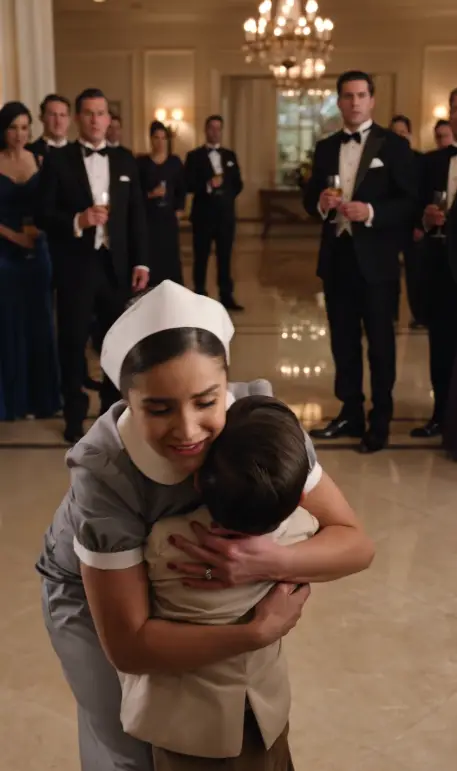
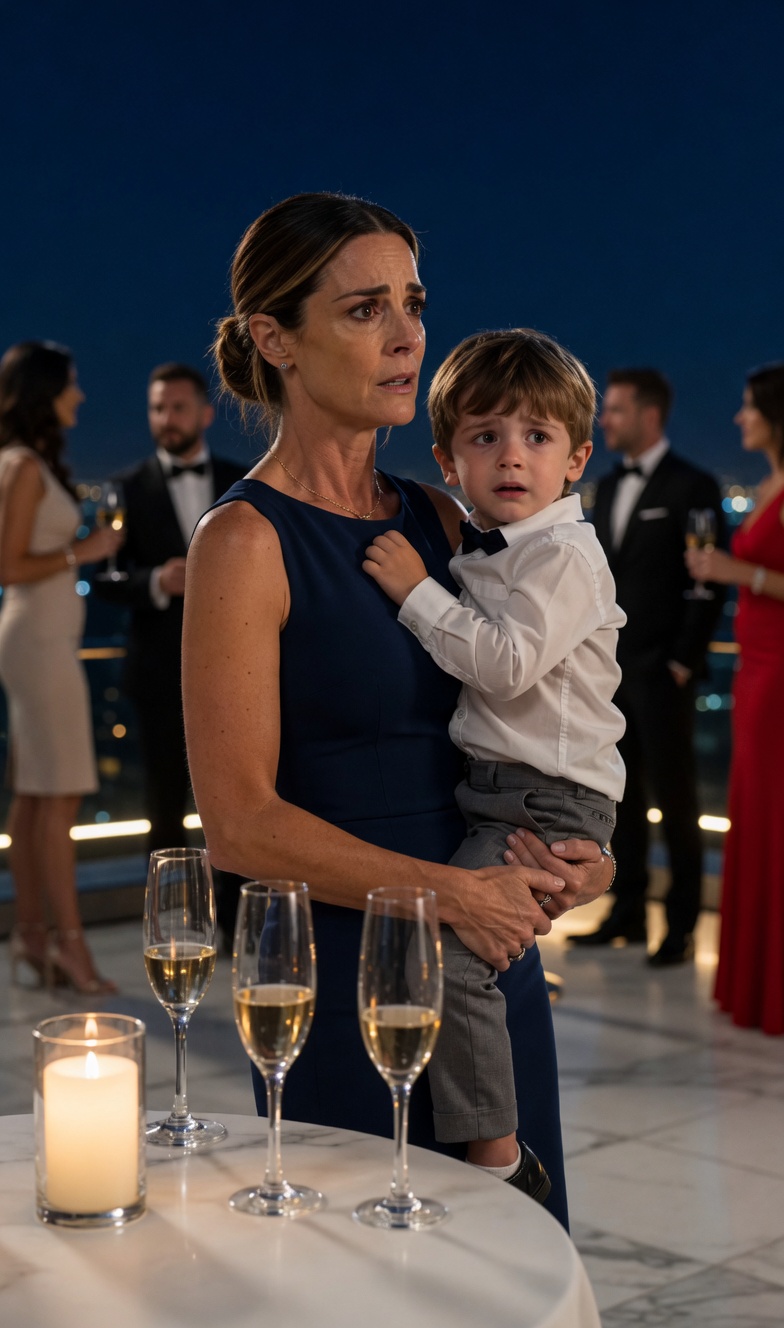
The rooftop went silent so fast it felt like the city itself had stopped breathing. My son was pressed against my chest, one small hand gripping the front of my dress, his little body shaking in a way I had never seen before. He wasn’t just crying anymore. He was stunned. Confused. Hurt in the deepest way a child can be hurt—by an adult who knew exactly how small he was and still chose to use power against him.
The woman in diamonds stood two steps away, calm enough to make the moment even uglier. Her name was Victoria Langley, and everyone at that wedding seemed to know it. She owned a luxury boutique on the ground floor of the same building, the kind of store where women like her smiled at mirrors more than people. She was rich, polished, adored by the bride’s family, and used to rooms bending around her before she even asked.
She looked down at me and my son like we were something spilled on the floor.
“If you can’t control your child,” she repeated, her voice sharp and clean, “you should leave.”
A few guests looked away.
Not because they disagreed.
Because they were embarrassed to be witnessing what they had quietly allowed.
The groom stood frozen near the floral arch. The bride had one hand over her mouth, but she said nothing. The DJ stared at his equipment as if the music had cut itself. A waiter holding a champagne tray looked at my son with heartbreak in his eyes, but even he did not move.
That was what I would remember most.
Not the slap.
The silence after it.
I kissed my son’s hair and whispered, “You’re okay, baby. I’ve got you.”
He shook his head against me. “Mommy, I wasn’t bad.”
Something inside me went completely still.
“No,” I said softly. “You weren’t.”
Then I stood.
Victoria’s lips curled slightly, as if she expected me to scream, to make a scene, to prove every ugly thing she had already decided about me. But I did not give her that. I wiped my son’s tears with my thumb, held him close with one arm, and reached into my purse with the other.
The groom’s uncle, Richard Hale, stepped forward awkwardly. He was one of those men who always seemed ready to manage things quietly before consequences became expensive.
“Let’s all calm down,” he said. “There’s no need to ruin the evening.”
I looked at him.
“Your evening was ruined when she hit my child.”
His face tightened. “I understand you’re upset, but perhaps this can be handled privately.”
Privately.
That word always appears when powerful people are afraid witnesses might become evidence.
I looked at Victoria. She lifted her chin, still wearing that diamond smile.
“Do what you need to do,” she said. “But don’t expect people here to pretend you belong.”
So I did exactly what I needed to do.
I called Marcus Reed, my property director.
He answered on the second ring. “Ms. Bennett?”
The groom’s uncle’s expression changed the moment he heard the name. Not much. Just enough. His eyes flicked from my phone to my face, then toward the edge of the rooftop where the city block stretched below us—restaurants, boutiques, valet parking, galleries, and Victoria’s luxury store glowing under its gold-lettered sign.
I spoke quietly.
“Marcus, freeze all tenant privileges for Langley Couture. Begin lease violation review immediately. Pull the security footage from the rooftop, lobby, and elevator. And notify legal that one of our tenants just assaulted my son at a private event on Bennett Holdings property.”
The rooftop went colder than the evening air.
Victoria’s smile disappeared.
Richard Hale went pale.
The bride finally whispered, “Bennett Holdings?”
I ended the call and slipped the phone back into my purse.
For the first time that night, Victoria looked at me like she was truly seeing me.
“What did you just say?” she asked.
I shifted my son higher on my hip. “You heard me.”
Richard stepped toward me, suddenly careful. “Ms. Bennett… are you Amelia Bennett?”
I held his stare. “Yes.”
A wave of whispers moved across the rooftop.
Some people knew immediately. Others learned from the phones already being pulled out, the quick searches, the wide eyes. Amelia Bennett. Owner of Bennett Holdings. The company that owned the entire block beneath them. The rooftop venue. The building. The retail units. The restaurant spaces. The parking structure. The storefront where Victoria sold $8,000 handbags to women she considered worthy.
Victoria had not slapped a random single mother’s child.
She had slapped the son of the woman who owned the ground under her heels.
Her face drained of color. “I didn’t know.”
That sentence almost made me laugh.
Not because it was funny.
Because people like her always think it helps.
“You didn’t know what?” I asked. “That he was my son? Or that he mattered?”
No one spoke.
Victoria’s mouth opened, then closed.
I stepped closer, not enough to threaten her, just enough that she had to look me in the eye.
“You hit a child because he annoyed you,” I said. “You humiliated a mother because you thought she had no status. You stood here surrounded by witnesses and called it standards.”
Her voice shook now. “I was overwhelmed. The crying was disruptive. I shouldn’t have—”
“No,” I cut in. “You shouldn’t have.”
A security team arrived through the rooftop entrance within minutes. Not wedding security. Mine. Men and women in black suits who knew the building, the cameras, the exits, and my son’s name. The lead guard, Elena Cruz, came straight to me.
“Ms. Bennett, do you want medical assistance for Noah?”
The sound of my son’s name made him cling tighter to me.
“Yes,” I said. “And police.”
Victoria’s eyes widened. “Police?”
“You assaulted my child.”
“It was a slap,” she whispered.
My voice stayed calm. “He is four.”
That ended the argument.
The bride began crying softly. The groom looked like he wanted to disappear. Richard Hale leaned close to Victoria, whispering something urgent, probably telling her to apologize before this became worse.
So she tried.
“Amelia,” she said, suddenly using my first name like we had ever shared air willingly, “I am sorry. Truly. I didn’t realize—”
I looked at her until she stopped.
“You still don’t.”
The police arrived. Statements were taken. Guests who had laughed now lowered their eyes when officers asked what they had seen. The man who had raised his phone earlier suddenly became useful because his video had captured everything: Victoria insulting us, my son crying, the slap, and her telling us to leave.
As she watched the officer review the footage, Victoria’s knees seemed to weaken.
The beautiful rooftop wedding had become a crime scene with roses.
And still, I did not feel victorious.
I felt tired.
I felt my son’s cheek against my neck.
I felt the small tremors in his breath.
That was all that mattered.
Before leaving, I turned to Richard Hale. “The event is over.”
He blinked. “The wedding?”
“The rooftop booking,” I said. “This property has safety standards. Unlike some people, we enforce them.”
The guests were escorted down in groups. The music never came back on. The champagne went untouched. The flowers looked ridiculous under the police lights.
Downstairs, as we passed the lobby, Victoria’s luxury store stood bright and perfect behind glass. Mannequins posed in silk. Diamond handbags rested under warm lighting. A gold sign on the door read: Langley Couture — Elegance Without Compromise.
My son looked at it and whispered, “Is that her store?”
“Yes,” I said.
“Do we have to go there?”
I kissed his forehead. “Never.”
The next morning, Bennett Holdings issued a formal notice to Langley Couture: lease review, conduct violation, pending termination, suspension of promotional access, and immediate investigation into customer discrimination complaints. Because once people started talking, more stories came out.
A teenage girl had been told not to touch a dress because “her kind usually stained things.”
A delivery driver had been forced to use the back alley during a storm while luxury clients used the front entrance.
A young Black mother had been followed through the store by security.
A housekeeper buying a scarf for her daughter had been laughed out of the boutique.
Victoria’s cruelty was not a moment.
It was a pattern.
And patterns leave records.
Within two weeks, her investors pulled back. Her publicist resigned. Her boutique’s lease was terminated after legal review confirmed multiple conduct breaches. The video from the rooftop spread online, but I never posted it. Someone else did. The world saw what happened, and for once, Victoria could not polish the story into something softer.
People asked if I felt guilty.
I didn’t.
But I did feel something heavier than satisfaction.
Because destroying her store did not erase the mark she left on my son’s heart. For days, Noah asked if he had been “too loud.” He asked if rich people hated crying. He asked if he should be quiet at parties so grown-ups wouldn’t get mad.
That hurt more than anything Victoria lost.
So I took him back to the rooftop one week later, when it was empty and calm. No wedding. No music. No guests. Just the skyline, the wind, and the soft glow of the city below.
He held my hand tightly. “Are we allowed here?”
I crouched in front of him. “Baby, this place belongs to us. But even if it didn’t, you would still belong wherever you are treated with kindness.”
He touched his cheek, though the redness was long gone. “She said we should leave.”
I nodded. “She was wrong.”
“Because we own it?”
I shook my head. “No. Because nobody has the right to hurt you. Not even people with money. Not even people in diamonds. Not even people who think they’re important.”
He thought about that for a long moment. Then he asked, “Can loud kids still be good kids?”
My throat tightened.
“Yes,” I whispered. “Loud kids can be tired kids. Scared kids. Happy kids. Good kids. You were always good.”
He finally smiled.
Small.
But real.
Months later, the empty boutique became something else. I turned it into a family resource center for single parents and children in crisis. Free legal aid. Childcare support. Emergency clothing. Counseling. A warm place where no one was judged by their shoes, their dress, their accent, or whether their child cried too loudly.
I named it Noah House.
On opening day, my son cut the ribbon with plastic safety scissors while reporters took photos. He wore sneakers, a blue jacket, and a serious expression because he had decided ribbon-cutting was “important business.”
Inside, near the entrance, I placed a small sign:
No child is a disruption. No mother is out of place.
People still ask me whether I destroyed Victoria’s life.
I always answer the same way.
No.
Victoria destroyed the illusion that her life was built on kindness.
I only made sure she could no longer profit from cruelty on property I owned.
And if anyone thinks that was too harsh, they can explain it to the little boy who was slapped at a wedding for crying.
Because I will never apologize for protecting my child.
Not privately.