He Threw His Pregnant Wife Out for a Rich Heiress… Five Years Later, She Returned With His Twins and Bought the Entire Wedding Venue
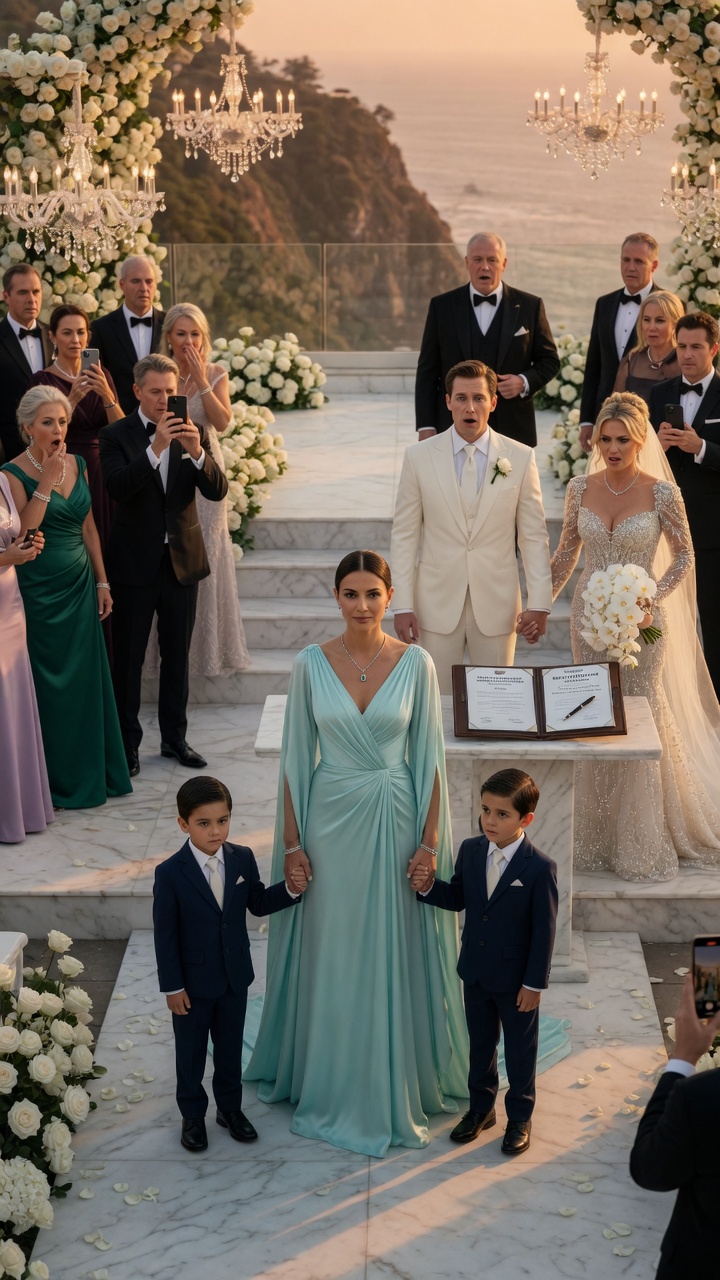
The ocean wind swept across the cliffside gardens of the Sterling Crest Resort, where white roses covered every archway, crystal chandeliers hung from glass pavilions, and three hundred guests from America’s richest circles waited for the wedding of the year. At the altar stood Nathan Whitaker, dressed in a custom ivory tuxedo, smiling like a man who believed the world had finally bowed at his feet. Five years earlier, he had been nothing more than a struggling real estate broker with overdue bills and expensive dreams, but today he was about to marry Ava Kingsley, the only daughter of the Kingsley hotel empire, a woman whose family name opened doors Nathan had spent his entire life trying to kick down. Ava stood beside him in a diamond-covered gown, glowing with triumph, not love. She leaned close enough for the front row to hear and whispered, “Do you think your ex-wife will actually come? Or do you think she’s still trying to find a dress at some clearance rack?” Her friends laughed behind their champagne glasses. Nathan smirked, adjusting his cufflinks. “Madison never belonged in places like this,” he said coldly. “I only invited her so she could finally understand the difference between a man with a future and a woman who was lucky I ever looked at her.” The laughter grew louder, polished and cruel, floating over the expensive garden like perfume. For a brief second, Nathan’s mind returned to the night he had ended his first marriage. It had been raining hard in their small apartment complex in Queens. Madison Reed, his wife then, had stood barefoot in the doorway, trembling as Nathan threw her suitcase onto the wet pavement. “You’re holding me back,” he had said, his voice empty of pity. “Ava can give me access, money, status—everything you never could. You’re a cashier with a tired smile and a cheap coat. Don’t pretend we were ever meant for the same life.” Madison had pressed one hand to her stomach, but Nathan never noticed. She had opened her mouth to tell him she was pregnant, that she had just found out that morning, that there were two tiny heartbeats growing inside her. But then she looked at the man who once promised to protect her and saw only ambition staring back. So she said nothing. She picked up her suitcase from the rain, swallowed every broken piece of herself, and disappeared into the night. Nathan believed she had vanished because she was weak. He never knew she had vanished because she was becoming stronger than he could survive. In the five years that followed, Madison built herself from ashes. She worked nights, studied finance before sunrise, invested every dollar she could spare, and used the sharp mind Nathan had always ignored to enter the luxury property market from the shadows. While people laughed at her old job, she learned how wealthy families hid debt behind polished names. While Nathan chased status through Ava, Madison quietly bought distressed hotels, restructured failing companies, and built Reed Capital Group into one of the most feared private investment firms in the country. She did all of it while raising her twin sons, Caleb and Carter, alone. They had Nathan’s dark eyes, Nathan’s sharp jawline, Nathan’s stubborn expression—but they had Madison’s heart. She never taught them hatred. She taught them discipline, kindness, and the truth that no one’s worth should ever depend on who chooses to stay. Her peace ended three weeks before Nathan’s wedding, when an ivory envelope arrived at her Manhattan penthouse. Inside was a gold-stamped invitation to Nathan Whitaker and Ava Kingsley’s wedding, along with a handwritten note: Madison, I saved you a seat in the back. I thought you deserved to see what success looks like up close. Don’t worry—no one will expect much from you. Madison stared at the note for a long time. Then she smiled, not with pain, but with the calmness of a woman who had just been handed the final missing piece of a plan already in motion. Back at Sterling Crest, the string quartet began playing as the officiant stepped forward. Nathan looked toward the back row, expecting to see Madison arrive quietly, embarrassed, maybe wearing something simple enough for Ava’s friends to mock. But the seat remained empty. Ava laughed softly. “Maybe she finally learned shame.” Nathan chuckled. “Good. It’s the first useful lesson she ever learned.” Then the music stopped. Not faded. Stopped. A low, powerful engine rolled through the estate gates, deep enough to vibrate through the marble aisle. Every guest turned as security rushed toward the entrance. A black Rolls-Royce Spectre glided into view, followed by two dark SUVs. The car stopped at the beginning of the white carpet. Two bodyguards stepped out first, scanning the garden with military stillness. Then the rear door opened. Madison Reed stepped out. The entire wedding fell silent. She wore a deep emerald silk gown that moved like water, simple enough to look effortless and expensive enough to make every woman in the garden understand it had not been chosen from a rack. Her hair was swept back elegantly, her face calm, her diamonds understated but unmistakably rare. She did not look like a woman coming to witness her ex-husband’s success. She looked like someone arriving to collect what already belonged to her. But what truly killed the laughter was not Madison’s dress, her car, or the security behind her. It was the two little boys who stepped out after her. Caleb and Carter, five years old, dressed in matching navy suits, walked to either side of their mother and took her hands. Nathan’s smile disappeared. His face drained of color. The boys looked exactly like him. The same eyes. The same chin. The same way one eyebrow lifted slightly when they studied a room. Ava saw it too. Her mouth tightened. “Nathan,” she whispered. “Who are those children?” Nathan could not answer. Madison walked slowly down the aisle, and something even more humiliating happened. The same billionaires who had laughed at Nathan’s jokes began standing. Not out of politeness. Out of recognition. A senator near the front leaned toward his wife and whispered, “That’s Madison Reed. Reed Capital.” A hotel magnate in the second row lowered his head slightly as she passed. A venture capitalist Nathan had spent years trying to meet stood as if a queen had entered the room. Ava’s father, William Kingsley, gripped the arm of his chair so hard his knuckles turned white. Nathan noticed and felt his stomach twist. Madison stopped two steps from the altar. Caleb looked at Nathan without emotion. Carter tilted his head, curious but unimpressed. Madison opened her clutch, removed a leather folder, and placed it on the small table beside the officiant. The sound was soft, but Nathan felt it like thunder. “You invited me to see what success looks like,” Madison said, her voice calm enough to make the entire garden lean closer. “So I came.” Ava snapped, “This is a private wedding. You have no right to interrupt.” Madison looked at her for the first time. “Actually, I have every right.” Ava laughed sharply, desperate to recover control. “Security, remove her.” The estate guards moved forward, but Madison’s bodyguards did not flinch. One of them simply raised a hand, and the guards stopped as if their bodies had remembered who was truly in charge. Madison turned back to Nathan. “Five years ago, you threw me out in the rain because you believed I was too poor to matter. You told me Ava could give you everything I never could.” Nathan swallowed. “Madison…” “No,” she said softly. “You don’t get to say my name like we are sharing a memory.” The garden froze. Madison placed one hand on each boy’s shoulder. “These are Caleb and Carter. My sons.” Nathan’s lips trembled. “Are they…” “Yours by blood,” Madison said. “Mine by love, sacrifice, and every sleepless night you were too busy climbing into another woman’s fortune to know they existed.” Gasps erupted through the crowd. Ava stepped back as if the boys had physically struck her. “That’s impossible,” she hissed. “He would have told me.” Madison’s eyes never left Nathan. “He couldn’t tell you what he never cared enough to learn.” Nathan stared at the children, and for the first time that day, he did not look like a groom. He looked like a man watching his own past stand in front of him wearing little suits. “Why didn’t you tell me?” he whispered. Madison’s expression hardened. “The night I almost told you, you called me worthless. You told me I was beneath the life you deserved. I decided my children would never begin their lives begging for love from a man who worshiped money more than loyalty.” William Kingsley suddenly stood. “Enough of this spectacle.” Madison turned toward him with a faint smile. “Mr. Kingsley, I was hoping you would join the conversation.” His face went gray. Ava looked between them. “Dad?” Madison opened the folder. “The Kingsley Group has been insolvent for twenty-seven months. Your family has been using borrowed money, inflated valuations, and private debt to maintain the illusion of power. Last night, Reed Capital acquired seventy-nine percent of that debt and enough voting shares to take control of the company.” The garden exploded in whispers. Reporters who had been invited to cover the glamorous ceremony began recording with shaking hands. Nathan looked at Ava. Ava looked at her father. William did not deny it. He only lowered his eyes. Madison continued, “That includes the resort chain, the private aircraft, the art holdings, the Miami residence, the Aspen lodge, and this property.” Ava’s voice cracked. “You’re lying.” Madison lifted a document from the folder and handed it to the officiant, who looked terrified to be holding it. “As of 9:00 this morning, Sterling Crest Resort is owned by Reed Capital Group.” She turned back to Nathan. “So technically, Alexander—sorry, Nathan—you are standing on my property.” A few guests gasped at the cold precision of the insult. Nathan shook his head slowly. “Madison, please…” She stepped closer, lowering her voice just enough for him and Ava to hear, while the silence made every word carry anyway. “You wanted me in the back row so I could watch you marry into wealth. Instead, you get to stand at the altar and learn that the fortune you sold your dignity for now belongs to the woman you threw away.” Ava’s composure shattered. “You ruined my wedding!” Madison looked at her calmly. “No. Your family ruined itself. I only bought the truth at a discount.” Nathan’s eyes filled with panic. “The boys… can I speak to them?” Caleb looked up at Madison. Carter squeezed her hand. Madison’s expression softened only for them. “That is their choice when they are old enough to understand what kind of man asks for children only after discovering their mother became powerful.” Nathan flinched. “I didn’t know.” “You didn’t ask,” Madison said. “There is a difference.” Then she turned to the guests. “The wedding may continue if the bride and groom wish. However, the Kingsley family has two hours to remove all personal property from the private residence wing. The corporate transfer is complete, and unauthorized occupation will be handled legally.” Ava screamed, “Dad, do something!” William Kingsley sat back down slowly, defeated before the entire elite world he had spent decades impressing. Nathan’s knees weakened. The altar, the flowers, the diamond dress, the cameras, the future he had bragged about—everything collapsed into one unbearable truth. He had not traded poverty for power. He had traded a family for an illusion. Madison took Caleb and Carter by the hand and walked back down the aisle. This time, no one laughed. Some guests bowed their heads. Others moved aside quickly, as if ashamed to have witnessed the cruelty that brought her there. Nathan stumbled forward. “Madison!” She stopped but did not turn. “I made a mistake,” he choked. Madison looked over her shoulder. “No, Nathan. A mistake is taking the wrong road. You chose the wrong heart.” Then she walked away. Behind her, Ava’s sobs turned into rage, William Kingsley’s empire died in public, and Nathan collapsed to his knees on the marble aisle, staring after the two sons who had walked past him like he was only another stranger at a ruined wedding. The Rolls-Royce doors closed, sealing Madison and her children away from the chaos. Inside the car, Caleb looked up at her. “Mom, was that man sad?” Madison stroked his hair gently. “Yes, sweetheart.” Carter frowned. “Did he do something bad?” Madison looked out at the fading estate, where the wedding guests were still standing in stunned silence. “He made choices that hurt people.” Caleb thought about that. “Do we have to hate him?” Madison’s eyes softened. She pulled both boys closer. “No. Hate is too heavy to carry. But we don’t have to let someone hurt us just because they are sorry after losing what they wanted.” The boys leaned against her, too young to understand the whole story but old enough to feel safe in her arms. That night, back in her penthouse overlooking Manhattan, Madison stood by the window while Caleb and Carter slept in the next room. The city shimmered beneath her like proof that survival could become architecture. Her assistant, Grace, entered quietly and placed the final acquisition file on the desk. “The Kingsley transfer is complete,” she said. “All assets are secured.” Madison nodded. “And the employee protections?” “Already activated. No hotel workers will lose their jobs because of the takeover.” Madison turned. “Good. The people at the bottom should never pay for the greed at the top.” Grace smiled faintly. “You won today.” Madison looked toward the hallway where her sons slept. “No,” she said. “I closed a chapter.” Miles away, Nathan sat alone in a hotel room he no longer had the right to occupy. Ava had locked herself in another suite, screaming into the phone while lawyers explained there was nothing left to save. William Kingsley had stopped answering calls. The wedding footage had already gone viral. Every headline told the same story: billionaire heiress exposed, groom confronted by powerful ex-wife, secret twins revealed at luxury wedding. But Nathan did not care about the headlines anymore. He kept seeing Caleb and Carter’s faces. His faces. His sons. He remembered Madison in the rain, one hand pressed to her stomach. He remembered the way she had looked at him, not only hurt, but as if she had just understood he was smaller than the dream she once had of him. He had called her worthless. Now she owned everything he had tried to marry into. But the money was not what broke him. It was the realization that Madison had not returned to win him back or even to destroy him. She had returned to show him the life he had thrown away, and then she had taken that life safely out of his reach. In the months that followed, Nathan tried to contact her. Letters. Emails. Legal requests. Apologies that began with regret and ended with excuses. Madison answered only once through her attorney: Any future contact regarding the children will be handled legally, with their emotional safety as the only priority. Nathan attended counseling because the court required it before any supervised introduction could even be considered. For the first time, he sat in rooms where no one cared about his suit, his contacts, or his ambition. They asked him what he had done. They asked him why he believed love was something he could discard and reclaim. They asked him whether he wanted to be a father or simply hated being excluded from the title. He had no easy answers. Madison, meanwhile, continued building her company, but something inside her became quieter after Sterling Crest. Revenge had not healed the lonely nights. It had not returned the years when she rocked two crying babies alone after working sixteen hours. It had not erase the fear of hospital bills, the exhaustion, or the memory of standing in the rain with nowhere to go. But it had given her closure. It had shown her that Nathan’s rejection had never been proof of her smallness. It had been proof of his blindness. One year later, Madison brought Caleb and Carter to a charity opening at one of the former Kingsley hotels, now converted partly into housing for single mothers rebuilding their lives. The lobby was filled with warm light, fresh flowers, children’s laughter, and women who looked nervous but hopeful as they walked into rooms that would give them safety instead of judgment. Madison stood at the entrance watching a young mother carry a sleeping baby through the doors. Caleb tugged her sleeve. “Mom, why are we helping them?” Madison smiled. “Because once, someone should have helped me.” Carter looked around. “But nobody did?” Madison knelt in front of them. “Not at first. So now we become the people who do.” Caleb nodded seriously. Carter hugged her. And for a moment, Madison felt something deeper than victory. She felt peace. Then her phone buzzed. A message from her attorney: Nathan Whitaker has completed the first phase of counseling. He is requesting permission to send the children a birthday card. Madison stared at the message for a long time. The old pain stirred, sharp but no longer controlling. She looked at her sons laughing near the lobby fountain, safe and loved and unaware of how carefully she had protected their world. She typed back: The card may be reviewed first. No promises beyond that. Grace, standing nearby, raised an eyebrow. “You’re considering it?” Madison watched Caleb help Carter fix his crooked bow tie. “I’m considering what is best for them. Not what punishes him.” Grace nodded. “That sounds hard.” Madison smiled faintly. “Being bitter is easy. Being free takes more work.” That evening, after the event ended, Madison took the boys to the rooftop garden of the hotel. The ocean wind moved softly around them, and the city lights flickered in the distance. Caleb and Carter ran ahead, chasing each other between rows of white roses that looked almost like the ones from the wedding day, only now they did not feel like decorations for humiliation. They felt like something reclaimed. Madison stood beneath the warm lights and remembered the woman she had been five years earlier: soaked from rain, pregnant, abandoned, told she was nothing. She wished she could go back and tell that woman what was waiting ahead. Not just money. Not power. Not applause from people who once would have ignored her. But two boys who would become her reason to keep standing. A life no man could define. A heart that could survive betrayal without becoming cruel. Caleb ran back to her, breathless. “Mom, are you happy?” Madison looked at him, then at Carter, then at the bright building filled with women who would not have to sleep in the cold the way she once feared she might. She thought of Nathan kneeling at the altar, of Ava screaming, of the empire that fell because it had been hollow from the beginning. Then she thought of her sons sleeping safely every night, of her own name on the company doors, of the silence inside her that no longer hurt. “Yes,” she said softly. “I am.” Carter grabbed her hand. Caleb grabbed the other. Together, they walked away from the edge of the rooftop and back toward the light. Madison did not look back. She had already learned the greatest revenge was not watching someone fall. It was becoming so whole that