By the time the organ reached its final movement, Graham Mercer almost believed the day was perfect.
The church was bright with stained-glass daylight, white flowers, polished wood pews, and warm candlelight. Guests filled both sides of the aisle, dressed like people who expected the wedding to appear in magazines.
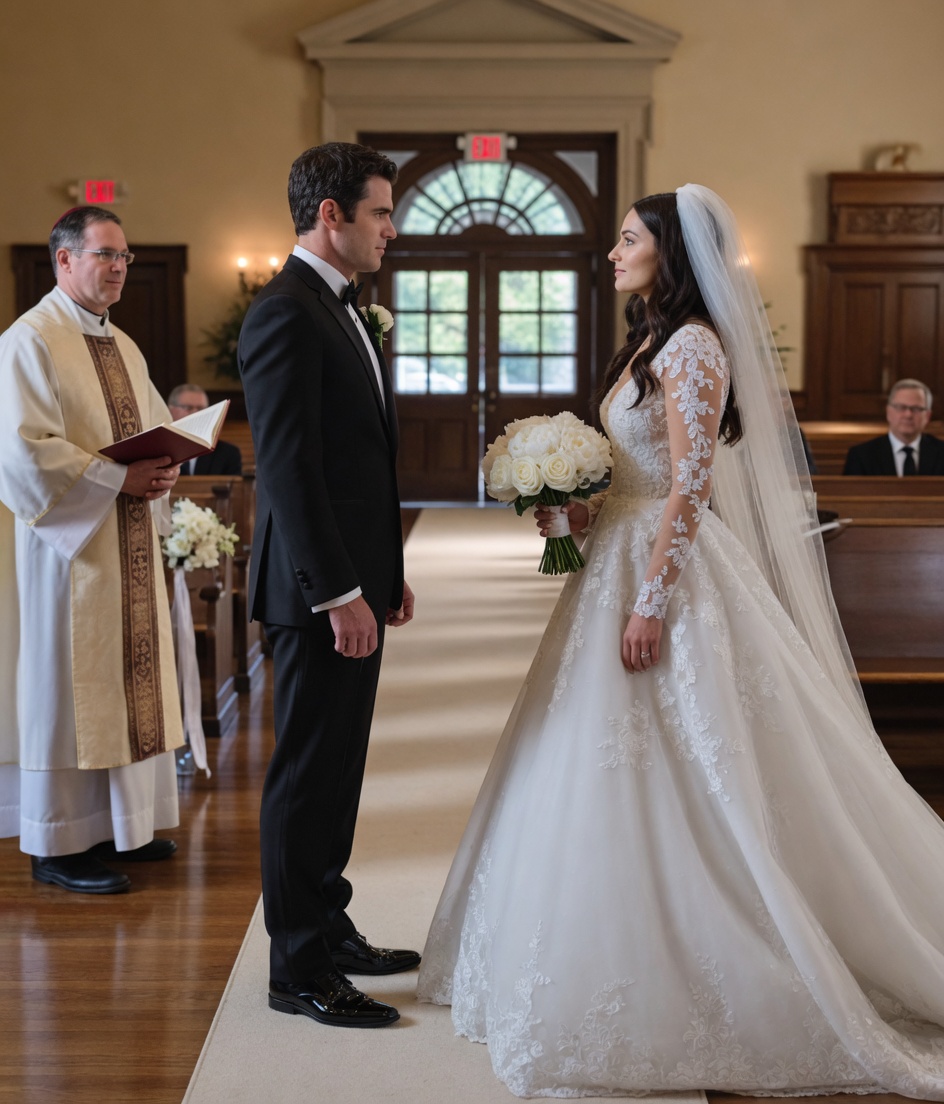
At the altar, Juliette Monroe stood across from him in a lace-and-satin gown, her veil falling over dark hair, her face calm and beautiful.
Graham had met her eleven months earlier at a charity dinner in Charleston. She was charming, educated, and careful with every word. She made him feel understood in a way he had not felt since his father died and left him running Mercer Shipping alone.
Some people had warned him that the relationship moved too quickly.
His sister had said, “You barely know her.”
His best man had asked why Juliette avoided every conversation about her past.
Even Kane, Graham’s black Doberman, had never accepted her. The dog was trained, obedient, and steady around almost everyone. But whenever Juliette entered a room, Kane watched her with rigid attention, ears high, body tense.
Juliette laughed it off at first.
Later, she insisted the dog made her nervous.
So Graham agreed Kane would stay at Mercer House with the handler until after the ceremony.
Now, standing at the altar, Graham tried not to think about that. He looked at Juliette, held her gloved hands, and told himself he was about to begin a good life.
Father Bannon opened the prayer book.
“If anyone here has cause to show why these two should not be joined in holy matrimony,” he said, “speak now, or forever hold your peace.”
The church was silent.
Then the rear doors burst open.
The organ stopped mid-note.
A black Doberman shot into the aisle, barking hard, nails striking the wood as guests jerked back in panic.
Graham turned sharply.
“Kane?!”
The dog sprinted straight toward the altar.
Juliette’s face changed before Kane reached her. Not confusion. Fear.
Kane leapt at the front of her gown, growling and snapping into the fabric near her waist. He did not bite her body. He tore at the dress.
Juliette stumbled backward, furious and terrified.
“Get him off me!”
Graham moved toward them, but Kane yanked again. Silk and lace ripped. Seed pearls scattered across the polished floor.
Then something dark slipped from under the torn layers of the gown.
It hit the wood with a sharp metallic clatter.
A black tactical knife lay near Graham’s shoe.
For one second, nobody moved.
Graham stared down at it, the color leaving his face.
“What the hell is this?”
Juliette looked at the knife.
She did not look surprised.
That was what hit Graham hardest.
A man rose from a side pew, moving fast. He was middle-aged, in a dark plain suit, with a badge in one hand and a handgun in the other. Two other plainclothes officers stood almost at the same time.
Guests recoiled into the pews.
Kane moved between Graham and Juliette, barking once, then growling low.
The detective stepped into the aisle.
“Don’t touch that knife.”
Juliette froze.
Her gown was ripped at the waist, one side of the skirt hanging loose. Her bridal expression was gone. Her eyes were hard now, cold and calculating.
The detective raised his weapon toward her.
“Juliette Monroe, don’t move.”
The church fell into stunned silence.
Graham looked from the detective to Juliette. “What is happening?”
The detective did not take his eyes off her. “Mr. Mercer, step away from her.”
Graham stepped back slowly.
Juliette’s mouth tightened.
Two officers moved up the aisle. Kane growled again, holding his position in front of Graham.
The detective spoke clearly, so the nearest guests could hear. “Her legal name is not Juliette Monroe. We believe she has used at least three identities in the last six years.”
Graham’s chest tightened.
“No.”
The detective glanced at him. “I’m sorry.”
Juliette finally spoke, but not to the detective. She looked at Graham.
“You don’t know what you’re doing.”
Graham stared at her.
Only an hour earlier, she had stood in a dressing room and let his mother fasten a bracelet around her wrist. She had kissed him and whispered, “By tonight, everything changes.”
Now that sentence came back to him differently.
The detective took another step forward.
“We have open investigations in Georgia, North Carolina, and Virginia,” he said. “Three wealthy men. Three quick marriages. Three deaths shortly after the ceremony. A fall. A drowning. A boating accident. All ruled accidental at first.”
A horrified murmur moved through the church.
Graham looked at Juliette.
She did not deny it.
His stomach turned.
The officers reached her. One took her arm. She twisted just enough to make him tighten his grip.
“Careful,” she snapped. “This dress costs more than your salary.”
No one laughed.
The second officer cuffed her over the white satin gloves.
That sound made the whole thing real.
Graham stepped back again, his heel catching on scattered pearls. His best man reached for him, but Graham barely felt it.
The detective nodded toward the knife. “She was carrying that under the gown. We believe tonight was going to be staged as a private accident after the reception.”
Graham remembered the honeymoon villa Juliette had chosen. Isolated. Cliffside. No neighboring houses close enough to hear anything.
He remembered the life insurance forms she had pushed him to update.
He remembered how she had never allowed Kane near her.
Kane had known.
Or at least he had known enough.
“How did he get here?” Graham asked, his voice rough.
The detective lowered his gun slightly as Juliette was secured. “Your handler called us twenty minutes ago. The dog broke free outside Mercer House and went straight for the car. He was tracking something on her dress from earlier. We had a unit close behind him, but he got inside first.”
Juliette laughed once under her breath.
“The dog,” she said. “Of course.”
Kane barked so suddenly she flinched.
It was the first honest reaction Graham had seen from her all day.
The officers led Juliette down the aisle. Guests pulled away from her path. Her veil dragged crookedly behind her, the torn train catching on the floor. No one reached to help her.
At the doors, she looked back once.
“You were easier than the others,” she said to Graham.
The words landed without drama. Cold. Flat. Final.
Then the doors closed behind her.
For a long moment, nobody inside the church moved.
The priest stood near the altar with the prayer book still in his hands. Graham’s mother sat in the front pew, crying silently. His best man finally put a hand on his shoulder, but Graham stepped away.
He sank onto the altar step.
Kane came to him immediately, pressing his head against Graham’s leg. The dog’s body was still tense, but the worst of the fight had left him.
Graham put one hand on Kane’s collar.
“You knew,” he whispered.
Kane stayed still.
Outside, sirens grew louder, then faded as the police cars pulled away from the church.
The detective returned a few minutes later after the knife had been bagged as evidence. He stood near Graham, careful not to crowd him.
“We’ve been watching her for weeks,” he said. “We didn’t have enough to arrest her before today. The identity fraud was strong, but not enough to stop the ceremony. We were waiting for her to make a move.”
“You let me stand up there with her.”
“We had officers in the church and outside every exit,” the detective said. “You were never out of sight.”
Graham looked up at him. “That’s supposed to make me feel better?”
“No,” the detective said. “It’s just the truth.”
Graham looked down the aisle where Juliette had been taken.
“How much of it was real?”
The detective was quiet for a moment.
“With people like her, it’s hard to know where the performance ends.”
That was answer enough.
The guests were slowly being guided outside. Some whispered. Some cried. Some looked at Graham and quickly looked away, as if his humiliation were another thing they should not touch.
Graham stood with Kane beside him.
His mother came to him first. She wrapped both arms around him, and for the first time since childhood, Graham let himself lean into her.
“I’m sorry,” she whispered.
He didn’t answer.
There was nothing useful to say.
By the next morning, Juliette’s real name was everywhere: Natalie Vale. Nora Kincaid. Rebecca Lane. The news called her the “Runaway Bride Killer” before the police even finished the first press conference.
Graham hated the name immediately.
It made her sound like a story.
She had nearly been his wife.
Investigators searched the hotel suite where she had stayed before the wedding. They found documents, burner phones, altered IDs, insurance paperwork, and notes about Graham’s schedule. They also found a sedative hidden in a cosmetics case.
The plan was simple.
Wedding. Reception. Private departure. Honeymoon flight the next morning. Somewhere before that, Graham would suffer an “accident” no one could explain quickly enough to save him.
Kane had changed the timing.
The dog had smelled something on the dress when Juliette came to Mercer House for photographs that morning. He had lunged then too, but Juliette screamed, and everyone thought the dog had become overstimulated. Graham had been embarrassed. He had ordered Kane taken away.
That part stayed with him.
He had ignored the one creature in his life that had not been fooled.
The trial came eight months later.
Graham testified for less than an hour. He answered every question clearly. Juliette watched him the whole time with no expression.
When the prosecutor showed the church surveillance footage, the courtroom went silent.
Kane sprinting down the aisle.
The dress tearing.
The knife falling.
Graham staring at the floor as his wedding ended in the space of ten seconds.
The jury convicted her on attempted murder, identity fraud, conspiracy, and charges tied to the earlier deaths. The other cases followed after that. Families of the dead men sat behind Graham in court. None of them spoke to him for long, but several shook his hand.
One woman held onto him a little longer than the others.
“My brother had a dog too,” she said. “She made him give it away.”
Graham had no answer.
After sentencing, he went home to Mercer House and found Kane lying in the front hall, head raised, waiting.
For weeks after the wedding, Graham avoided the church, the photographs, the unopened gifts, and most calls. He kept only a few people close. His mother. His sister. His best man. Kane.
Especially Kane.
At night, when sleep would not come, Graham walked the property with him. No music. No phone. Just the dog moving a few feet ahead, stopping whenever Graham stopped, looking back as if checking that he was still there.
Three months after the trial, Graham returned to St. Michael’s.
Not for a ceremony.
Not for closure.
The church was empty except for Father Bannon, who let him in through a side door and then left him alone.
The flowers were gone. The candles were gone. The aisle had been polished clean.
Graham stood where he had stood that day and looked toward the rear doors.
Kane sat beside him.
For a long time, Graham said nothing.
Then he bent down, clipped the leash onto Kane’s collar, and walked out through the same doors the dog had broken open.
Outside, the afternoon was cool and bright.